In Figure 8.10, the energetic coupling of substrate phosphorylation and an endergonic reaction are shown. If the hydrolysis of ATP releases 7.3 kcal of free energy, use the graph in this figure to estimate what you would expect the ∆G values to be for the uncoupled reaction and the two steps in the coupled reaction.
Verified step by step guidance
1
Identify the free energy change (ΔG) for the uncoupled reaction by observing the energy difference between the reactants (A + B) and the product (AB) in the uncoupled reaction graph.
Note that the hydrolysis of ATP releases 7.3 kcal/mol of free energy, which is used to drive the coupled reaction.
In the coupled reaction, determine the ΔG for the first step (formation of BP) by observing the energy difference between the reactants (A + ATP) and the intermediate (BP).
Determine the ΔG for the second step (formation of AB) by observing the energy difference between the intermediate (BP) and the final product (AB).
Sum the ΔG values of the two steps in the coupled reaction to find the overall ΔG for the coupled reaction.
Verified video answer for a similar problem:
This video solution was recommended by our tutors as helpful for the problem above.
Video duration:
1m
Play a video:
0 Comments
Key Concepts
Here are the essential concepts you must grasp in order to answer the question correctly.
Energetic Coupling
Energetic coupling refers to the process where an exergonic reaction (which releases energy) drives an endergonic reaction (which requires energy). In biological systems, this often involves the hydrolysis of ATP, which releases energy that can be harnessed to perform work, such as synthesizing molecules. Understanding this concept is crucial for analyzing how cells manage energy to facilitate various biochemical reactions.
Gibbs Free Energy (∆G) is a thermodynamic quantity that indicates the spontaneity of a reaction. A negative ∆G value signifies that a reaction is exergonic and can occur spontaneously, while a positive ∆G indicates an endergonic reaction that requires energy input. In the context of the question, estimating the ∆G values for the coupled and uncoupled reactions is essential for understanding their energy dynamics.
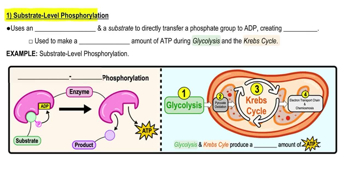
Substrate phosphorylation is a biochemical process where a phosphate group is transferred to a substrate molecule, often from ATP, resulting in the formation of a phosphorylated intermediate. This process is critical in metabolic pathways, as it can activate or deactivate enzymes and facilitate the conversion of substrates into products. In the context of the figure, it illustrates how energy from ATP hydrolysis is utilized to drive the synthesis of products in coupled reactions.

 1:17 minutes
 Verified step by step guidance
 04:57
04:57