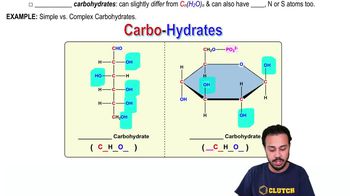
Which of the differences listed here could be found among molecules of the same monosaccharide? Select True or False for each statement.T/F There is a difference in the orientation of a hydroxyl group in the ring form.T/F There is a difference in the number of carbons.T/F There is a difference in the position of the carbonyl group in the linear form.T/F There is a difference in the overall shape of the molecule—one is a ring and the other is linear.
Verified step by step guidance
1
Identify the structure of a monosaccharide, which typically contains a carbon backbone, hydroxyl groups (-OH), and a carbonyl group (C=O).
Consider the first statement: In the ring form of a monosaccharide, the orientation of hydroxyl groups can vary, leading to different isomers (e.g., alpha and beta forms).
Evaluate the second statement: Monosaccharides have a fixed number of carbons, such as glucose with six carbons, so the number of carbons does not change among molecules of the same monosaccharide.
Analyze the third statement: In the linear form, the position of the carbonyl group can vary, leading to different isomers (e.g., aldoses and ketoses), but not within the same monosaccharide type.
Examine the fourth statement: Monosaccharides can exist in both linear and ring forms, which are different shapes of the same molecule.
Verified video answer for a similar problem:

This video solution was recommended by our tutors as helpful for the problem above
Video duration:
2m
Play a video:
Was this helpful?
Key Concepts
Here are the essential concepts you must grasp in order to answer the question correctly.
Monosaccharide Structure
Monosaccharides are the simplest form of carbohydrates, consisting of a single sugar unit. They typically contain a carbon backbone, a carbonyl group (aldehyde or ketone), and multiple hydroxyl groups. Understanding their structure is crucial for analyzing differences in orientation and configuration, particularly when comparing their linear and ring forms.
Isomerism refers to the existence of compounds with the same molecular formula but different structural arrangements. In monosaccharides, isomers can differ in the orientation of functional groups, such as hydroxyl groups, leading to variations in their chemical properties and biological functions. Recognizing isomerism is essential for evaluating the statements regarding differences among molecules of the same monosaccharide.
Monosaccharides can exist in both linear and cyclic forms, with the ring form being more stable in aqueous solutions. The conversion between these forms involves the reaction of the carbonyl group with a hydroxyl group, resulting in different spatial arrangements. Understanding this dynamic is key to addressing questions about differences in shape and orientation within the same monosaccharide.