What holds cellulose molecules together in bundles large enough to form fibers?
a. the cell wall
b. peptide bonds
c. hydrogen bonds
d. hydrophobic interactions
Verified step by step guidance
1
Identify the structure of cellulose, which is a polysaccharide composed of glucose units linked by β-1,4-glycosidic bonds.
Understand that cellulose molecules form linear chains that can align parallel to each other.
Recognize that these parallel chains are held together by intermolecular forces.
Consider the types of intermolecular forces that can occur between cellulose chains, such as hydrogen bonds, which are common in biological molecules.
Conclude that hydrogen bonds are responsible for holding cellulose molecules together in bundles large enough to form fibers.
Verified video answer for a similar problem:
This video solution was recommended by our tutors as helpful for the problem above.
Video duration:
2m
Play a video:
0 Comments
Key Concepts
Here are the essential concepts you must grasp in order to answer the question correctly.
Cellulose Structure
Cellulose is a polysaccharide composed of long chains of glucose units linked by β-1,4-glycosidic bonds. These chains can align parallel to each other, forming microfibrils that provide structural support in plant cell walls. Understanding the structure of cellulose is essential for grasping how it forms fibers.
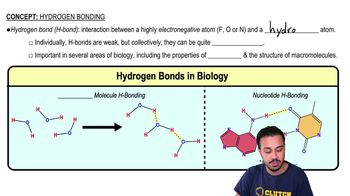
Hydrogen bonds are weak attractions that occur between a hydrogen atom covalently bonded to an electronegative atom and another electronegative atom. In cellulose, hydrogen bonds form between hydroxyl groups on adjacent cellulose chains, helping to stabilize the structure and hold the molecules together in bundles.
The cell wall is a rigid outer layer found in plant cells, primarily composed of cellulose, hemicellulose, and lignin. It provides structural integrity and protection. The interaction of cellulose fibers within the cell wall is crucial for understanding how they form larger structures and contribute to the overall strength of plant tissues.

 2:46 minutes
 Verified step by step guidance
 4:16
4:16