What type of bond is formed between two sugars in a disaccharide?a. glycosidic linkageb. phosphodiester bondc. peptide bondd. hydrogen bond
Verified step by step guidance
1
Identify the two sugar molecules involved in forming a disaccharide.
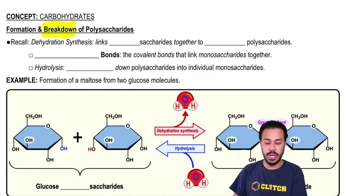
Understand that a disaccharide is formed when two monosaccharides undergo a dehydration reaction.
Recognize that during this reaction, a water molecule is removed, allowing the two sugar molecules to bond.
Determine the type of bond that typically forms between two sugar molecules in this context.
Conclude that the bond formed between two sugars in a disaccharide is a glycosidic linkage.
Verified video answer for a similar problem:
This video solution was recommended by our tutors as helpful for the problem above
Video duration:
1m
Play a video:
Was this helpful?
Key Concepts
Here are the essential concepts you must grasp in order to answer the question correctly.
Disaccharides
Disaccharides are carbohydrates formed by the combination of two monosaccharides through a condensation reaction. This process results in the release of a water molecule and the formation of a covalent bond between the sugar units. Common examples include sucrose (glucose + fructose) and lactose (glucose + galactose). Understanding disaccharides is essential for recognizing how they function in biological systems.
A glycosidic linkage is a type of covalent bond that connects two sugar molecules in carbohydrates. It is formed when the hydroxyl group of one sugar reacts with the anomeric carbon of another, resulting in the release of water. This bond is crucial for the structure and function of disaccharides and polysaccharides, influencing their digestibility and energy storage capabilities.
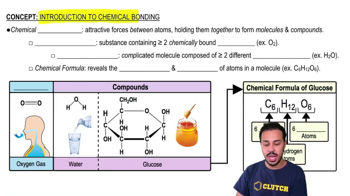
Chemical bonds are the forces that hold atoms together in molecules. In the context of carbohydrates, different types of bonds include glycosidic linkages, peptide bonds (in proteins), phosphodiester bonds (in nucleic acids), and hydrogen bonds (which can stabilize structures). Understanding these bonds is vital for grasping how molecules interact and form complex biological structures.