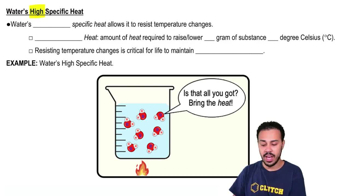
A slice of pizza has 500 kcal. If we could burn the pizza and use all the heat to warm a 50-L container of cold water, what would be the approximate increase in the temperature of the water? (Note: A liter of cold water weighs about 1 kg.)
a. 50°C
b. 5°C
c. 100°C
d. 10°C
Verified step by step guidance
1
Identify the energy content of the pizza slice, which is 500 kcal.
Convert the energy from kilocalories to calories, knowing that 1 kcal = 1000 cal, so 500 kcal = 500,000 cal.
Use the formula for heat transfer: \( q = mc\Delta T \), where \( q \) is the heat energy (in calories), \( m \) is the mass of the water (in grams), \( c \) is the specific heat capacity of water (1 cal/g°C), and \( \Delta T \) is the change in temperature.
Determine the mass of the water: 50 L of water is equivalent to 50 kg, which is 50,000 g.
Rearrange the formula to solve for \( \Delta T \): \( \Delta T = \frac{q}{mc} \), and substitute the known values to find the temperature change.
Verified video answer for a similar problem:
This video solution was recommended by our tutors as helpful for the problem above.
Video duration:
3m
Play a video:
0 Comments
Key Concepts
Here are the essential concepts you must grasp in order to answer the question correctly.
Caloric Energy
Caloric energy refers to the amount of energy provided by food, measured in kilocalories (kcal). In this scenario, the pizza provides 500 kcal, which can be converted into heat energy to warm the water. Understanding how caloric energy translates into thermal energy is essential for calculating temperature changes.
Specific heat capacity is the amount of heat required to raise the temperature of a unit mass of a substance by one degree Celsius. For water, this value is approximately 4.18 J/g°C. This concept is crucial for determining how much the temperature of the water will increase when heat is added from the burning pizza.
Heat transfer is the process of thermal energy moving from one object to another due to a temperature difference. In this case, the heat generated from burning the pizza is transferred to the cold water, resulting in a temperature increase. Understanding the principles of heat transfer helps in calculating the final temperature of the water after absorbing the heat.

 3:29 minutes
 Verified step by step guidance
 4:58
4:58