Differentiate clearly between primary, secondary, and tertiary protein structure.
Verified step by step guidance
1
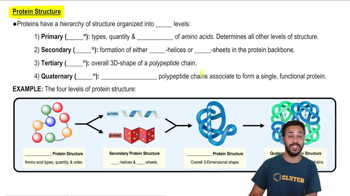
Step 1: Define the primary structure of a protein as the unique sequence of amino acids linked together by peptide bonds, forming a polypeptide chain. This sequence determines the protein's identity and properties.
Step 2: Explain the secondary structure as the local folding of the polypeptide chain into regular structures such as alpha-helices and beta-pleated sheets, stabilized mainly by hydrogen bonds between backbone atoms.
Step 3: Describe the tertiary structure as the overall three-dimensional shape of a single polypeptide chain, formed by interactions among the side chains (R groups) of amino acids, including hydrophobic interactions, ionic bonds, hydrogen bonds, and disulfide bridges.
Step 4: Highlight that the primary structure is the linear sequence, the secondary structure involves local folding patterns, and the tertiary structure is the full 3D conformation of the entire polypeptide.
Step 5: Optionally, mention that tertiary structure determines the protein's functional properties and that disruptions in any level of structure can affect protein function.
Verified video answer for a similar problem:
This video solution was recommended by our tutors as helpful for the problem above
Video duration:
2m
Play a video:
Was this helpful?
Key Concepts
Here are the essential concepts you must grasp in order to answer the question correctly.
Primary Protein Structure
The primary structure of a protein is the linear sequence of amino acids linked by peptide bonds. This sequence determines the protein's unique characteristics and serves as the foundation for higher-level structures.
Secondary structure refers to local folding patterns within a protein, such as alpha-helices and beta-pleated sheets, stabilized mainly by hydrogen bonds between backbone atoms.
Tertiary structure is the overall three-dimensional shape of a single polypeptide chain, formed by interactions among side chains, including hydrophobic interactions, disulfide bonds, and ionic bonds.