State the all-or-none principle of action potentials.
Verified step by step guidance
1
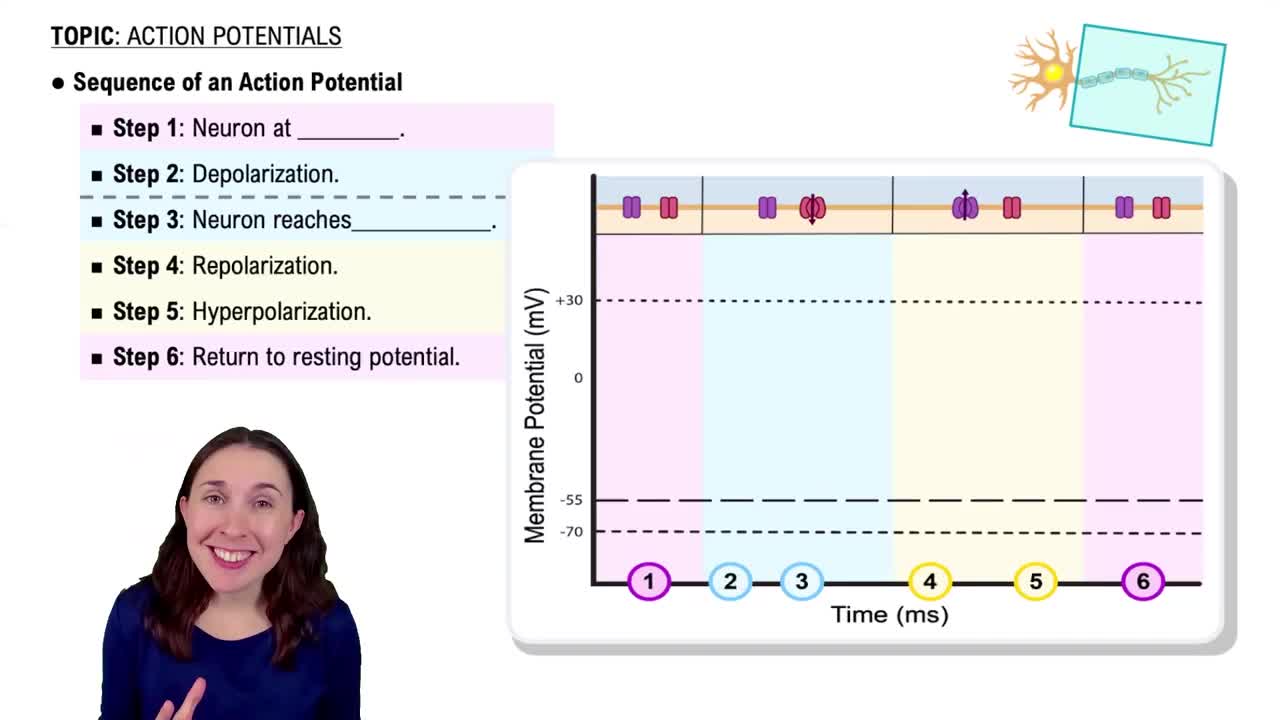
Understand that the all-or-none principle refers to how action potentials are generated in neurons or muscle cells.
Recognize that once the membrane potential reaches a certain threshold, an action potential will be triggered; if the threshold is not reached, no action potential occurs.
Know that the action potential, once initiated, always propagates along the membrane at a consistent amplitude and speed, without decreasing in strength.
Realize that this means the cell either fires a full action potential or does not fire at all—there is no partial or weaker action potential.
Summarize the principle as: an action potential either happens completely when threshold is met, or it does not happen at all if threshold is not reached.
Verified video answer for a similar problem:
This video solution was recommended by our tutors as helpful for the problem above
Video duration:
2m
Play a video:
Was this helpful?
Key Concepts
Here are the essential concepts you must grasp in order to answer the question correctly.
Action Potential
An action potential is a rapid, temporary change in the electrical membrane potential of a neuron or muscle cell, allowing the transmission of signals along the cell. It involves a sequence of depolarization and repolarization phases caused by ion movements across the membrane.
The all-or-none principle states that an action potential either occurs fully or not at all. If the stimulus reaches the threshold, a complete action potential is generated; if it does not, no action potential occurs, ensuring consistent signal strength.
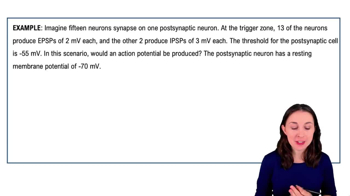
Threshold potential is the critical level of membrane depolarization that must be reached to trigger an action potential. It acts as a gatekeeper, determining whether the neuron will fire, thus playing a key role in the all-or-none response.