Compare and contrast substrate-level phosphorylation and oxidative phosphorylation.
Verified step by step guidance
1
Identify the main processes involved in ATP production: substrate-level phosphorylation and oxidative phosphorylation.
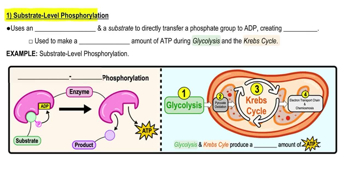
Explain substrate-level phosphorylation: it occurs directly in the metabolic pathways such as glycolysis and the citric acid cycle, where a phosphate group is directly transferred from a substrate to ADP to form ATP.
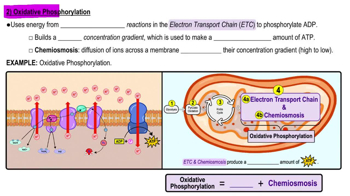
Describe oxidative phosphorylation: it takes place in the mitochondria and involves the electron transport chain and chemiosmosis, where ATP is produced from ADP and inorganic phosphate using energy derived from the transfer of electrons through a series of protein complexes.
Compare the energy sources: substrate-level phosphorylation uses energy from the breakdown of substrates, while oxidative phosphorylation uses energy from the electron transport chain.
Contrast the efficiency and location: substrate-level phosphorylation is less efficient and occurs in the cytoplasm and mitochondrial matrix, whereas oxidative phosphorylation is more efficient and occurs across the inner mitochondrial membrane.
Verified video answer for a similar problem:
This video solution was recommended by our tutors as helpful for the problem above.
Video duration:
4m
Play a video:
0 Comments
Key Concepts
Here are the essential concepts you must grasp in order to answer the question correctly.
Substrate-Level Phosphorylation
Substrate-level phosphorylation is a metabolic process that directly generates ATP by transferring a phosphate group from a substrate molecule to ADP. This occurs in specific enzymatic reactions, primarily during glycolysis and the citric acid cycle. Unlike oxidative phosphorylation, it does not involve the electron transport chain and is less efficient in terms of ATP yield.
Oxidative phosphorylation is a process that produces ATP through the electron transport chain and chemiosmosis, occurring in the mitochondria. Electrons from NADH and FADH2 are transferred through a series of proteins, creating a proton gradient that drives ATP synthesis via ATP synthase. This method is more efficient than substrate-level phosphorylation, yielding significantly more ATP per glucose molecule.
The comparison of ATP yield between substrate-level and oxidative phosphorylation highlights their efficiency differences. Substrate-level phosphorylation typically produces 2 ATP molecules per glucose during glycolysis and the citric acid cycle, while oxidative phosphorylation can yield approximately 28-34 ATP molecules per glucose, depending on the cell's conditions. Understanding this difference is crucial for grasping cellular energy production.

 4:51 minutes
 Verified step by step guidance
 02:59
02:59