Ch. 17 The Special Senses
Martini - Fundamentals of Anatomy & Physiology 11th Edition
Martini, Nath, Bartholomew11th EditionFundamentals of Anatomy & PhysiologyISBN: 9780136874089Not the one you use?Change textbook
Chapter 17, Problem 4

Sound waves are converted into mechanical movements by the
(a) Auditory ossicles
(b) Cochlea
(c) Oval window
(d) Round window
(e) Tympanic membrane

Verified step by step guidance
1
Understand the pathway of sound waves in the ear: Sound waves first enter the ear canal and strike the tympanic membrane (eardrum), causing it to vibrate.
Recognize that these vibrations need to be transmitted to the inner ear, where they can be converted into nerve impulses.
Identify the structure responsible for converting sound waves into mechanical movements: The auditory ossicles (malleus, incus, and stapes) are tiny bones in the middle ear that receive vibrations from the tympanic membrane and amplify them.
Note that the cochlea is involved in converting mechanical movements into electrical signals, not the initial conversion of sound waves into mechanical movements.
Conclude that the auditory ossicles are the structures that convert sound waves into mechanical movements, transmitting vibrations from the tympanic membrane to the oval window.

Verified video answer for a similar problem:

This video solution was recommended by our tutors as helpful for the problem above.
Was this helpful?

Key Concepts

Here are the essential concepts you must grasp in order to answer the question correctly.

Tympanic Membrane

The tympanic membrane, or eardrum, vibrates when sound waves hit it, initiating the conversion of sound energy into mechanical energy. It acts as the first mechanical interface in the middle ear, transmitting vibrations to the auditory ossicles.
Recommended video:
06:49
Biological Membranes

Auditory Ossicles

The auditory ossicles are three tiny bones (malleus, incus, stapes) in the middle ear that amplify and transmit mechanical vibrations from the tympanic membrane to the inner ear. They play a crucial role in converting sound waves into mechanical movements.
Recommended video:
1:10
The Cerebrum Example 6

Cochlea

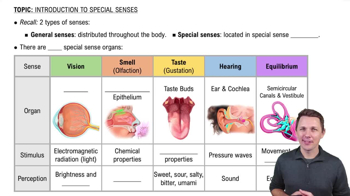
The cochlea is a spiral-shaped organ in the inner ear that converts mechanical vibrations into neural signals. While it processes mechanical movements into electrical impulses, it does not convert sound waves directly into mechanical movements.
Recommended video:
Guided course
5:05
Special Senses