
What happens to the pH of a solution when hydrogen ions are added? a. The pH increases. b. The pH decreases. c. The pH does not change. d. The pH does not measure hydrogen ion concentration.
Verified step by step guidance
1
Understand the relationship between pH and hydrogen ion concentration: pH is a measure of the hydrogen ion (H⁺) concentration in a solution. It is calculated using the formula: , where [H⁺] represents the concentration of hydrogen ions.
Recall that pH is inversely related to hydrogen ion concentration: As the concentration of hydrogen ions ([H⁺]) increases, the pH value decreases, indicating a more acidic solution. Conversely, as [H⁺] decreases, the pH value increases, indicating a more basic solution.
Analyze the effect of adding hydrogen ions to a solution: Adding hydrogen ions increases the [H⁺] in the solution. According to the formula, this will result in a lower pH value.
Eliminate incorrect answer choices: a) 'The pH increases' is incorrect because adding hydrogen ions decreases pH. c) 'The pH does not change' is incorrect because pH is directly affected by changes in [H⁺]. d) 'The pH does not measure hydrogen ion concentration' is incorrect because pH specifically measures [H⁺].
Conclude that the correct answer is b) 'The pH decreases,' as adding hydrogen ions to a solution increases [H⁺], which lowers the pH value.
Verified video answer for a similar problem:
This video solution was recommended by our tutors as helpful for the problem above
Play a video:
Was this helpful?
Key Concepts
Here are the essential concepts you must grasp in order to answer the question correctly.
pH Scale
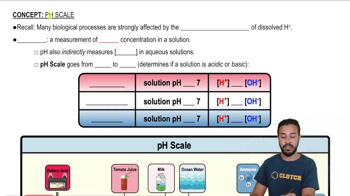
The pH scale measures the acidity or alkalinity of a solution, ranging from 0 to 14. A pH of 7 is considered neutral, while values below 7 indicate acidity and values above 7 indicate alkalinity. The scale is logarithmic, meaning each whole number change represents a tenfold change in hydrogen ion concentration.
Hydrogen ions (H+) are positively charged ions that play a crucial role in determining the acidity of a solution. When H+ ions are added to a solution, they increase the concentration of hydrogen ions, which typically results in a decrease in pH, indicating a more acidic environment.
An acid-base reaction involves the transfer of protons (H+) between substances. Acids release H+ ions in solution, while bases accept them. The addition of hydrogen ions to a solution is a direct action of an acid, leading to a decrease in pH and an increase in acidity.