Table of contents
- 0. Math Review
- 1. Intro to Physics Units
- 2. 1D Motion / Kinematics
- Vectors, Scalars, & Displacement
- Average Velocity
- Intro to Acceleration
- Position-Time Graphs & Velocity
- Conceptual Problems with Position-Time Graphs
- Velocity-Time Graphs & Acceleration
- Calculating Displacement from Velocity-Time Graphs
- Conceptual Problems with Velocity-Time Graphs
- Calculating Change in Velocity from Acceleration-Time Graphs
- Graphing Position, Velocity, and Acceleration Graphs
- Velocity Functions with Calculus
- Acceleration Functions with Calculus
- Kinematics Equations
- Vertical Motion and Free Fall
- Catch/Overtake Problems
- 3. Vectors
- Review of Vectors vs. Scalars
- Introduction to Vectors
- Adding Vectors Graphically
- Vector Composition & Decomposition
- Adding Vectors by Components
- Trig Review
- Unit Vectors
- Introduction to Dot Product (Scalar Product)
- Calculating Dot Product Using Components
- Intro to Cross Product (Vector Product)
- Calculating Cross Product Using Components
- 4. 2D Kinematics
- 5. Projectile Motion
- 6. Intro to Forces (Dynamics)
- 7. Friction, Inclines, Systems
- 8. Centripetal Forces & Gravitation
- Uniform Circular Motion
- Period and Frequency in Uniform Circular Motion
- Centripetal Forces
- Vertical Centripetal Forces
- Flat Curves
- Banked Curves
- Newton's Law of Gravity
- Gravitational Forces in 2D
- Acceleration Due to Gravity
- Satellite Motion: Intro
- Satellite Motion: Speed & Period
- Geosynchronous Orbits
- Overview of Kepler's Laws
- Kepler's First Law
- Kepler's Third Law
- Kepler's Third Law for Elliptical Orbits
- Gravitational Potential Energy
- Gravitational Potential Energy for Systems of Masses
- Escape Velocity
- Energy of Circular Orbits
- Energy of Elliptical Orbits
- Black Holes
- Gravitational Force Inside the Earth
- Mass Distribution with Calculus
- 9. Work & Energy
- 10. Conservation of Energy
- Intro to Energy Types
- Gravitational Potential Energy
- Intro to Conservation of Energy
- Energy with Non-Conservative Forces
- Springs & Elastic Potential Energy
- Solving Projectile Motion Using Energy
- Motion Along Curved Paths
- Rollercoaster Problems
- Pendulum Problems
- Forces from Potential Energy Functions using Calculus
- Energy in Connected Objects (Systems)
- Force & Potential Energy
- 11. Momentum & Impulse
- Intro to Momentum
- Intro to Impulse
- Impulse with Variable Forces
- Calculating Impulse with Calculus
- Intro to Conservation of Momentum
- Push-Away Problems
- Types of Collisions
- Completely Inelastic Collisions
- Adding Mass to a Moving System
- Collisions & Motion (Momentum & Energy)
- Ballistic Pendulum
- Collisions with Springs
- Elastic Collisions
- How to Identify the Type of Collision
- Intro to Center of Mass
- 12. Rotational Kinematics
- 13. Rotational Inertia & Energy
- More Conservation of Energy Problems
- Conservation of Energy in Rolling Motion
- Parallel Axis Theorem
- Intro to Moment of Inertia
- Moment of Inertia via Integration
- Moment of Inertia of Systems
- Moment of Inertia & Mass Distribution
- Intro to Rotational Kinetic Energy
- Energy of Rolling Motion
- Types of Motion & Energy
- Conservation of Energy with Rotation
- Torque with Kinematic Equations
- Rotational Dynamics with Two Motions
- Rotational Dynamics of Rolling Motion
- 14. Torque & Rotational Dynamics
- 15. Rotational Equilibrium
- 16. Angular Momentum
- Opening/Closing Arms on Rotating Stool
- Conservation of Angular Momentum
- Angular Momentum & Newton's Second Law
- Intro to Angular Collisions
- Jumping Into/Out of Moving Disc
- Spinning on String of Variable Length
- Angular Collisions with Linear Motion
- Intro to Angular Momentum
- Angular Momentum of a Point Mass
- Angular Momentum of Objects in Linear Motion
- 17. Periodic Motion
- 18. Waves & Sound
- 19. Fluid Mechanics
- 20. Heat and Temperature
- Temperature
- Linear Thermal Expansion
- Volume Thermal Expansion
- Moles and Avogadro's Number
- Specific Heat & Temperature Changes
- Latent Heat & Phase Changes
- Intro to Calorimetry
- Calorimetry with Temperature and Phase Changes
- Advanced Calorimetry: Equilibrium Temperature with Phase Changes
- Phase Diagrams, Triple Points and Critical Points
- Heat Transfer
- 21. Kinetic Theory of Ideal Gases
- 22. The First Law of Thermodynamics
- 23. The Second Law of Thermodynamics
- 24. Electric Force & Field; Gauss' Law
- Electric Charge
- Charging Objects
- Charging By Induction
- Conservation of Charge
- Coulomb's Law (Electric Force)
- Coulomb's Law with Calculus
- Electric Field
- Electric Fields with Calculus
- Electric Fields in Capacitors
- Electric Field Lines
- Dipole Moment
- Electric Fields in Conductors
- Electric Flux
- Electric Flux with Calculus
- Gauss' Law
- 25. Electric Potential
- 26. Capacitors & Dielectrics
- 27. Resistors & DC Circuits
- 28. Magnetic Fields and Forces
- 29. Sources of Magnetic Field
- 30. Induction and Inductance
- 31. Alternating Current
- 32. Electromagnetic Waves
- 33. Geometric Optics
- 34. Wave Optics
- 35. Optical Instruments
- 36. Special Relativity
34. Wave Optics
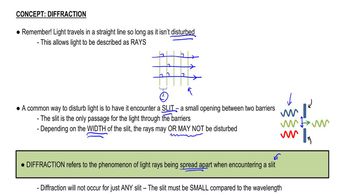
Diffraction
34. Wave Optics
Diffraction
 08:44
08:44

Learn with other creators

Practice this topic
- Multiple ChoiceA diffraction grating with is illuminated by two wavelengths of light: and What is the distance between the bright fringes of the two colors of light on a screen away?2186views
- Multiple ChoiceA diffraction grating has If it is illuminated by a laser at how many bright spots will be observed on a screen placed behind the grating?2437views1comments
- Multiple ChoiceA particular kind of oil with an index of refraction of has spilled on water. The different thicknesses of the oil slick result in different colors being strongly reflected at different parts of the spill. But near the edges, you identify the thinnest part of the oil layer that strongly reflects green light with a wavelength of 550 nm when you are directly overhead. What is the thickness of the oil at this point? Assume light is incident normal to the oil surface.2204views
- Multiple ChoiceYou place one glass slide on top of another, with an animal hair between them at one end. You illuminate the slides with blue light of wavelength You count along the slide and find 300 transitions from bright to dark and back to light. How thick is the hair?1816views