Ch. 8 Special Senses
Marieb - Essentials of Human Anatomy & Physiology 13th Edition
Marieb13th EditionEssentials of Human Anatomy & PhysiologyISBN: 9780135624340Not the one you use?Change textbook
Chapter 8, Problem 10

Sounds entering the external acoustic meatus are eventually converted to nerve impulses via a chain of events including:
a. Vibration of the eardrum
b. Vibratory motion of the ossicles against the oval window
c. Stimulation of hair cells in the spiral organ of Corti
d. Resonance of the cupula

Verified step by step guidance
1
Step 1: Understand the anatomy of the ear and the process of sound transmission. Sound waves enter the external acoustic meatus (ear canal) and cause the eardrum (tympanic membrane) to vibrate. This vibration is the first step in converting sound waves into mechanical energy. This corresponds to option 'a'.
Step 2: Learn about the ossicles (malleus, incus, and stapes), which are small bones in the middle ear. The vibratory motion of the eardrum is transmitted to these ossicles, and the stapes presses against the oval window, amplifying the sound vibrations. This corresponds to option 'b'.
Step 3: Explore the structure of the cochlea, specifically the spiral organ of Corti. Vibrations from the oval window create waves in the cochlear fluid, which stimulate hair cells in the spiral organ of Corti. These hair cells convert mechanical energy into nerve impulses. This corresponds to option 'c'.
Step 4: Clarify the term 'resonance of the cupula.' The cupula is part of the vestibular system, not the auditory system. It is involved in detecting head movements and balance, not sound transmission. Therefore, option 'd' does not apply to this question.
Step 5: Review the chain of events: sound waves cause the eardrum to vibrate (a), the ossicles transmit vibrations to the oval window (b), and the hair cells in the spiral organ of Corti are stimulated to generate nerve impulses (c). Eliminate any options unrelated to sound transmission, such as 'd'.

Verified video answer for a similar problem:

This video solution was recommended by our tutors as helpful for the problem above.
Video duration:
3m
Was this helpful?

Key Concepts

Here are the essential concepts you must grasp in order to answer the question correctly.

Sound Transmission

Sound waves enter the ear through the external acoustic meatus and cause the eardrum to vibrate. This initial vibration is crucial as it sets off a chain reaction that leads to the conversion of sound waves into nerve impulses, allowing the brain to interpret sound.
Recommended video:
Guided course
7:54
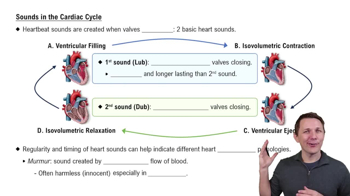
Sounds in the Cardiac Cycle

Ossicular Chain

The ossicles, which are three tiny bones in the middle ear (malleus, incus, and stapes), amplify and transmit the vibrations from the eardrum to the oval window of the cochlea. This mechanical process is essential for effective sound transmission and plays a key role in hearing.
Recommended video:
07:41
Electron Transport Chain

Hair Cells and the Organ of Corti

The spiral organ of Corti, located within the cochlea, contains hair cells that are sensitive to fluid movement caused by sound vibrations. When these hair cells are stimulated, they generate nerve impulses that are sent to the brain, allowing for the perception of sound.
Recommended video:
06:51
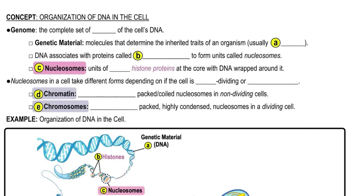
Organization of DNA in the Cell