Make a concept map (see BioSkills 12) that relates the four levels of protein structure and shows how they can contribute to the formation of hemoglobin. Your map should include the following boxed terms: Primary structure, Secondary structure, Tertiary structure, Quaternary structure, Amino acid sequence, R-groups, αα-helices, and ββ-pleated sheets.
Verified step by step guidance
1
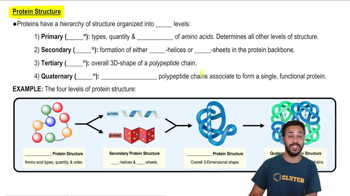
Identify the four levels of protein structure: Primary, Secondary, Tertiary, and Quaternary.
Label the boxes A, B, C, and D with the appropriate protein structure levels. A is Secondary structure, B is Tertiary structure, C is Quaternary structure, and D is R-groups.
Connect the Primary structure to the Amino acid sequence, as the primary structure is the sequence of amino acids in a polypeptide chain.
Connect the Secondary structure (A) to α-helices and β-pleated sheets, as these are the common structures formed by hydrogen bonds between the backbone atoms in the polypeptide chain.
Connect the Tertiary structure (B) to R-groups, as the tertiary structure is formed by interactions between the R-groups of the amino acids, and the Quaternary structure (C) to Multiple amino acid chains, as it involves the assembly of multiple polypeptide chains into a functional protein complex.
Was this helpful?
Key Concepts
Here are the essential concepts you must grasp in order to answer the question correctly.
Protein Structure Levels
Proteins have four levels of structure: primary, secondary, tertiary, and quaternary. The primary structure is the linear sequence of amino acids, while the secondary structure includes local folding patterns like α-helices and β-pleated sheets. The tertiary structure refers to the overall 3D shape of a single polypeptide chain, and the quaternary structure involves the assembly of multiple polypeptide chains into a functional protein, such as hemoglobin.
The amino acid sequence is the specific order of amino acids in a protein, determined by the genetic code. This sequence is crucial as it dictates how the protein will fold and function. Variations in the amino acid sequence can lead to different protein structures and functions, which is particularly important in the context of hemoglobin, where specific sequences are vital for oxygen binding.
R-groups, or side chains, are the variable parts of amino acids that determine their unique properties. These groups influence how amino acids interact with each other, affecting the protein's folding and stability. In hemoglobin, the interactions between R-groups contribute to the formation of its quaternary structure, allowing it to effectively transport oxygen in the blood.