The mitochondria in a eukaryotic cell .a. serve as the cell's power plants;b. probably evolved from a prokaryotic ancestor;c. can live independently of the eukaryotic cell;d. A and B are correct;e. A, B, and C are correct
Verified step by step guidance
1
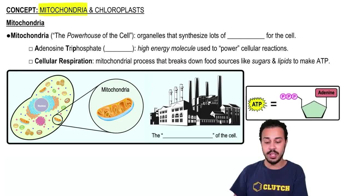
Identify the role of mitochondria in eukaryotic cells, which is to generate ATP, the energy currency of the cell, thus serving as the cell's power plants.
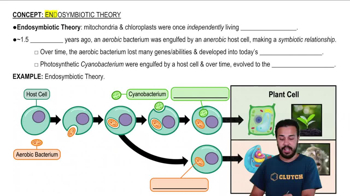
Consider the endosymbiotic theory, which suggests that mitochondria evolved from free-living prokaryotic organisms that were engulfed by ancestral eukaryotic cells.
Evaluate whether mitochondria can live independently of the eukaryotic cell, noting that they rely on the host cell for certain functions and cannot survive independently.
Analyze the options: (a) is correct as mitochondria are the power plants of the cell, (b) is correct as they likely evolved from prokaryotic ancestors, and (c) is incorrect as mitochondria cannot live independently.
Conclude that the correct answer is the option that includes both (a) and (b) but not (c), which is option (d).
Was this helpful?
Key Concepts
Here are the essential concepts you must grasp in order to answer the question correctly.
Mitochondrial Function
Mitochondria are known as the powerhouses of the cell because they generate adenosine triphosphate (ATP), the primary energy currency of the cell, through cellular respiration. This process involves converting nutrients into energy, which is essential for various cellular functions and overall metabolism.
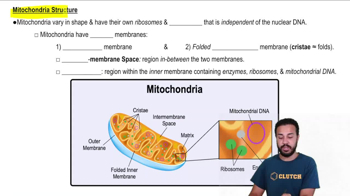
The endosymbiotic theory posits that mitochondria originated from free-living prokaryotic organisms that were engulfed by ancestral eukaryotic cells. This theory explains the double membrane structure of mitochondria and their own DNA, which is similar to that of bacteria, supporting the idea of a symbiotic relationship.
While mitochondria are integral to eukaryotic cells, they possess some autonomy, such as the ability to replicate independently of the cell cycle. However, they cannot survive indefinitely outside the eukaryotic cell, as they rely on the host cell for certain proteins and nutrients, highlighting a complex interdependence.