What are three attributes of mitochondria and chloroplasts that suggest they were once free-living bacteria?
Verified step by step guidance
1
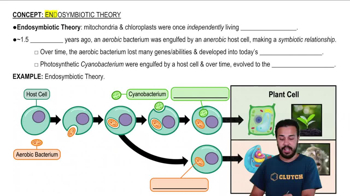
Identify the concept of endosymbiotic theory, which suggests that mitochondria and chloroplasts originated from free-living bacteria that were engulfed by ancestral eukaryotic cells.
Recognize that both mitochondria and chloroplasts have their own circular DNA, similar to bacterial DNA, which supports the idea that they were once independent organisms.
Note that mitochondria and chloroplasts have double membranes, which is consistent with the engulfing mechanism described in the endosymbiotic theory, where the inner membrane is derived from the original bacterial membrane and the outer membrane from the host cell.
Understand that mitochondria and chloroplasts replicate independently of the cell cycle through a process similar to binary fission, which is how bacteria reproduce.
Consider that both organelles have their own ribosomes, which are more similar in size and structure to bacterial ribosomes than to the eukaryotic ribosomes found in the cytoplasm of the host cell.
Verified video answer for a similar problem:
This video solution was recommended by our tutors as helpful for the problem above.
Video duration:
3m
Play a video:
0 Comments
Key Concepts
Here are the essential concepts you must grasp in order to answer the question correctly.
Endosymbiotic Theory
The endosymbiotic theory posits that mitochondria and chloroplasts originated from free-living bacteria that were engulfed by ancestral eukaryotic cells. This theory explains how these organelles have retained their own DNA and replicate independently of the cell, suggesting a symbiotic relationship that evolved over time.
Both mitochondria and chloroplasts are surrounded by a double membrane, which is a characteristic feature of prokaryotic cells. The inner membrane is thought to be derived from the original bacterial membrane, while the outer membrane may have originated from the host cell's membrane, indicating their prokaryotic ancestry.
Mitochondria and chloroplasts contain their own circular DNA, similar to bacterial genomes, and possess ribosomes that resemble those of prokaryotes. This genetic similarity supports the idea that these organelles were once independent bacteria, as they can produce some of their own proteins, further reinforcing their evolutionary history.

 3:12 minutes
 Verified step by step guidance
 07:29
07:29