Which of the following is a false statement regarding enzymes?
a. Enzymes are proteins that speed up metabolic reactions;
b. Enzymes have specific substrates;
c. Enzymes supply ATP to their substrates;
d. An enzyme may be used many times.
Verified step by step guidance
1
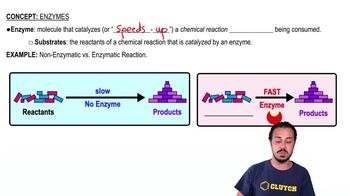
Identify the general function of enzymes in biological systems, which is to act as catalysts that speed up chemical reactions without being consumed in the process.
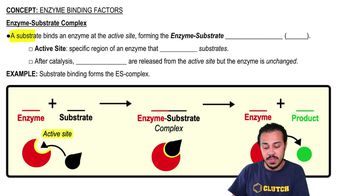
Understand that enzymes are highly specific, meaning each enzyme typically acts on a specific substrate, a substance that the enzyme helps transform.
Review the role of ATP (adenosine triphosphate) in cellular processes. ATP is a molecule that provides energy for various cellular activities, but it is not supplied by enzymes to their substrates.
Analyze each statement provided in the question to determine which one does not accurately describe the properties or functions of enzymes.
Conclude which statement is false based on the fundamental roles and characteristics of enzymes.
Verified video answer for a similar problem:
This video solution was recommended by our tutors as helpful for the problem above.
Video duration:
2m
Play a video:
0 Comments
Key Concepts
Here are the essential concepts you must grasp in order to answer the question correctly.
Enzyme Function
Enzymes are biological catalysts that accelerate chemical reactions in living organisms. They lower the activation energy required for reactions, allowing metabolic processes to occur more efficiently. This function is crucial for maintaining life, as many biochemical reactions would be too slow without enzymes.
Enzymes exhibit specificity for their substrates, meaning each enzyme typically catalyzes a specific reaction with a particular substrate. This specificity is due to the unique shape and chemical properties of the enzyme's active site, which only fits certain substrate molecules, ensuring precise biochemical interactions.
Enzymes are not consumed in the reactions they catalyze; instead, they can be reused multiple times. After facilitating a reaction, an enzyme returns to its original state, ready to bind to new substrate molecules. This property makes enzymes highly efficient and vital for sustaining metabolic pathways.

 2:49 minutes
 Verified step by step guidance
 02:32
02:32