How does pH affect enzyme-catalyzed reactions?a. Protons serve as substrates for most reactions.b. Energy stored in protons is used to drive endergonic reactions.c. Proton concentration increases the kinetic energy of the reactants, enabling them to reach their transition state.d. The concentration of protons affects an enzyme's folded structure and reactivity.
Verified step by step guidance
1
Understand that enzymes are proteins that catalyze biochemical reactions, and their activity can be influenced by environmental factors such as pH.
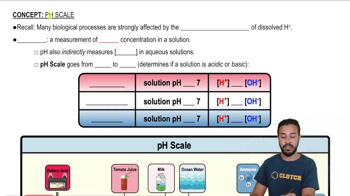
Recognize that pH is a measure of the hydrogen ion (proton) concentration in a solution, which can affect the charge and shape of an enzyme.
Consider how changes in pH can alter the ionization of amino acids at the active site of the enzyme, potentially affecting substrate binding and the enzyme's catalytic activity.
Evaluate how extreme pH levels can lead to denaturation, where the enzyme loses its specific three-dimensional structure, thus affecting its functionality.
Conclude that option d is the most relevant, as it addresses how proton concentration (pH) can influence an enzyme's structure and reactivity, impacting its ability to catalyze reactions.
Verified video answer for a similar problem:
This video solution was recommended by our tutors as helpful for the problem above
Video duration:
2m
Play a video:
Was this helpful?
Key Concepts
Here are the essential concepts you must grasp in order to answer the question correctly.
Enzyme Structure and Function
Enzymes are biological catalysts that speed up chemical reactions by lowering the activation energy. Their activity is highly dependent on their three-dimensional structure, which can be altered by changes in pH. A proper pH ensures that enzymes maintain their optimal shape, allowing them to bind substrates effectively and catalyze reactions.
pH is a measure of the concentration of hydrogen ions (protons) in a solution. Changes in pH can affect the protonation state of amino acids in an enzyme's active site, influencing its reactivity and binding affinity. This means that variations in pH can either enhance or inhibit enzyme activity, depending on the enzyme's specific requirements.
Transition state theory posits that reactants must reach a high-energy transition state before forming products. The concentration of protons can influence the kinetic energy of reactants, potentially facilitating their transition to this state. However, the stability of the transition state is also affected by the enzyme's structure, which is sensitive to pH changes.