If an enzyme in solution is saturated with substrate, the most effective way to obtain a faster yield of products is to
a. add more of the enzyme.
b. heat the solution to 90°C.
c. add more substrate.
d. add a noncompetitive inhibitor.
Verified step by step guidance
1
Understand the concept of enzyme saturation: When an enzyme is saturated with substrate, it means that all active sites of the enzyme molecules are occupied by substrate molecules.
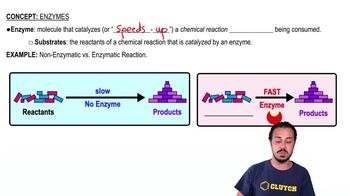
Consider the effect of adding more enzyme: Adding more enzyme increases the number of active sites available for the substrate, potentially increasing the rate of reaction.
Evaluate the effect of heating the solution: Heating the solution to 90°C may denature the enzyme, reducing its activity and potentially stopping the reaction.
Assess the impact of adding more substrate: Adding more substrate will not increase the reaction rate if the enzyme is already saturated, as there are no additional active sites available.
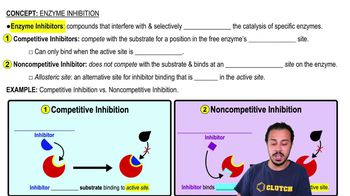
Consider the role of a noncompetitive inhibitor: Adding a noncompetitive inhibitor would decrease the reaction rate by altering the enzyme's function, even if the enzyme is saturated with substrate.
Verified video answer for a similar problem:
This video solution was recommended by our tutors as helpful for the problem above.
Video duration:
47s
Play a video:
0 Comments
Key Concepts
Here are the essential concepts you must grasp in order to answer the question correctly.
Enzyme Saturation
Enzyme saturation occurs when all active sites of the enzyme molecules are occupied by substrate, leading to a maximum reaction rate. At this point, adding more substrate does not increase the rate of product formation, as the enzyme is already working at full capacity.
Increasing the concentration of the enzyme can enhance the reaction rate when the substrate is saturated. More enzyme molecules mean more active sites available for substrate binding, allowing for a higher yield of products, provided that substrate availability is not a limiting factor.
Noncompetitive inhibitors bind to an enzyme regardless of whether the substrate is present, reducing the overall number of active enzyme molecules. This type of inhibition does not increase the reaction rate and can lead to a decrease in product yield, making it an ineffective choice when the enzyme is already saturated.

 0:47 minutes
 Verified step by step guidance
 02:55
02:55