Ch. 3 Cells: The Living Units
Marieb - Human Anatomy & Physiology 7th Edition
Marieb, Hoehn7th EditionHuman Anatomy & PhysiologyISBN: 9780805359091Not the one you use?Change textbook
Chapter 3, Problem 12

A physiologist observes that the concentration of sodium inside a cell is decidedly lower than that outside the cell. She also observes that there is a small leakage of sodium into the cell. What cellular process prevents the sodium concentration gradient from disappearing?
a. Osmosis
b. Diffusion
c. Primary active transport
d. Secondary active transport

Verified step by step guidance
1
Step 1: Understand the scenario described. Sodium concentration is lower inside the cell compared to outside, and sodium ions tend to leak into the cell due to this concentration gradient.
Step 2: Recognize that diffusion (option b) is the passive movement of ions from an area of higher concentration to lower concentration, which explains the leakage of sodium into the cell but does not prevent the gradient from disappearing.
Step 3: Consider osmosis (option a), which involves the movement of water across a membrane, not ions like sodium, so it is not the process maintaining the sodium gradient.
Step 4: Identify that to maintain a concentration gradient against the natural diffusion, the cell must use energy-dependent transport mechanisms, which are active transport processes.
Step 5: Differentiate between primary active transport (option c), which uses ATP directly to pump sodium out of the cell, and secondary active transport (option d), which uses the energy from another ion's gradient. The process that directly prevents the sodium gradient from disappearing is primary active transport.

Verified video answer for a similar problem:

This video solution was recommended by our tutors as helpful for the problem above.
Video duration:
3m
Was this helpful?

Key Concepts

Here are the essential concepts you must grasp in order to answer the question correctly.

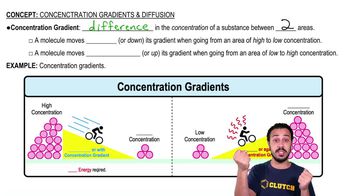
Sodium Concentration Gradient

The sodium concentration gradient refers to the difference in sodium ion concentration inside and outside the cell. Typically, sodium is much higher outside the cell than inside, creating a gradient that drives sodium to move into the cell by diffusion. Maintaining this gradient is essential for many cellular functions, including nerve impulse transmission and muscle contraction.
Recommended video:
04:51
Concentration Gradients and Diffusion

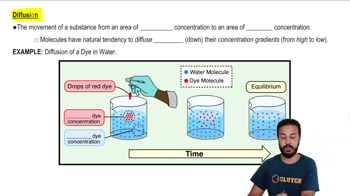
Diffusion and Leakage of Sodium

Diffusion is the passive movement of molecules from an area of higher concentration to lower concentration. Sodium ions tend to leak into the cell down their concentration gradient through channels or leaks, which would eventually equalize concentrations if unopposed. This leakage is a passive process and does not require energy.
Recommended video:
02:44
Diffusion

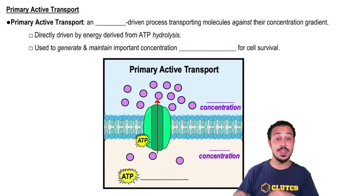
Primary Active Transport

Primary active transport uses energy, usually from ATP hydrolysis, to move ions against their concentration gradient. The sodium-potassium pump is a classic example, pumping sodium out of the cell and potassium in, maintaining the sodium gradient despite leakage. This process is vital to preserve cellular homeostasis and membrane potential.
Recommended video:
02:53
Primary Active Transport