
A certain reaction pathway consists of four steps. How would decreasing the amount of enzyme that catalyzes the second step affect the amount of product produced at the end of the pathway?
Verified step by step guidance
1
Step 1: Understand that in a multi-step reaction pathway, each step is catalyzed by a specific enzyme, and the overall rate of product formation depends on the slowest (rate-limiting) step.
Step 2: Recognize that decreasing the amount of enzyme catalyzing the second step will reduce the rate at which this step occurs, potentially making it the new rate-limiting step if it was not already.
Step 3: Consider that when the second step slows down, intermediates before this step may accumulate, while steps after it receive fewer substrates, leading to a decrease in the overall flow through the pathway.
Step 4: Conclude that a slower second step will reduce the overall rate of product formation at the end of the pathway because the pathway cannot proceed faster than its slowest step.
Step 5: Summarize that decreasing the enzyme amount for the second step decreases the amount of final product produced, as the bottleneck created limits the throughput of the entire pathway.
Verified video answer for a similar problem:
This video solution was recommended by our tutors as helpful for the problem above
Video duration:
5m
Play a video:
Was this helpful?
Key Concepts
Here are the essential concepts you must grasp in order to answer the question correctly.
Enzyme Catalysis and Reaction Rate
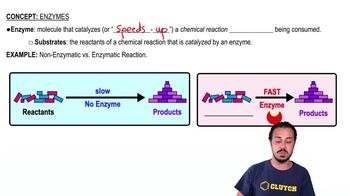
Enzymes speed up chemical reactions by lowering activation energy, increasing the reaction rate. Reducing enzyme concentration typically slows the catalyzed step, affecting the overall pathway speed.
In a multi-step reaction, the slowest step controls the overall rate, known as the rate-limiting step. Decreasing enzyme in the second step may make it rate-limiting, reducing the final product formation.
Slowing an intermediate step causes accumulation of upstream substrates and reduces downstream product flow. This bottleneck decreases the amount of final product produced in the pathway.