Different proteins are composed of different sequences of .
a. sugars;
b. lipids;
c. fats;
d. amino acids;
e. carbohydrates
Verified step by step guidance
1
Understand that proteins are macromolecules essential for various biological functions.
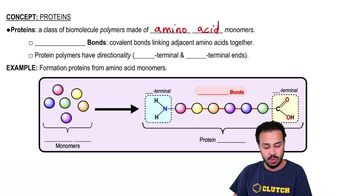
Recall that proteins are polymers made up of smaller units called monomers.
Identify the monomers that make up proteins, which are linked together in specific sequences.
Consider the options provided: sugars, lipids, fats, amino acids, and carbohydrates.
Recognize that the correct monomers that form proteins are amino acids.
Verified video answer for a similar problem:
This video solution was recommended by our tutors as helpful for the problem above.
Video duration:
27s
Play a video:
0 Comments
Key Concepts
Here are the essential concepts you must grasp in order to answer the question correctly.
Proteins
Proteins are large, complex molecules made up of long chains of amino acids. They play critical roles in the body, including catalyzing biochemical reactions, providing structural support, and regulating cellular processes. The specific sequence of amino acids in a protein determines its unique structure and function.
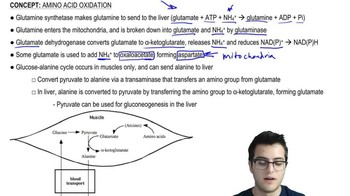
Amino acids are organic compounds that serve as the building blocks of proteins. There are 20 different amino acids, each with a unique side chain that influences the protein's properties. The sequence and arrangement of these amino acids dictate how a protein folds and functions, making them essential for protein diversity.
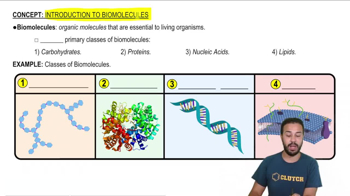
Biomolecules are organic molecules that are essential for life, including proteins, carbohydrates, lipids, and nucleic acids. Each type of biomolecule has distinct roles; for instance, proteins are involved in catalysis and structure, while carbohydrates provide energy. Understanding the differences among these biomolecules is crucial for grasping biological processes.

 0:27 minutes
 Verified step by step guidance
 02:50
02:50