The structural level of a protein least affected by a disruption in hydrogen bonding is the
a. primary level.
b. secondary level.
c. tertiary level.
d. quaternary level.
Verified step by step guidance
1
Understand the structure of proteins, which are made up of amino acids linked by peptide bonds forming a polypeptide chain.
Recognize that the primary structure of a protein is its unique sequence of amino acids in the polypeptide chain, which is held together by peptide bonds.
Identify that the secondary structure includes alpha helices and beta sheets, which are stabilized by hydrogen bonds between the backbone atoms in the polypeptide chain.
Note that the tertiary structure is the overall three-dimensional shape of a single polypeptide chain, stabilized by various interactions including hydrogen bonds, ionic bonds, hydrophobic interactions, and disulfide bridges.
Acknowledge that the quaternary structure involves the arrangement of multiple polypeptide subunits, which are also stabilized by interactions similar to those in the tertiary structure.
Verified video answer for a similar problem:
This video solution was recommended by our tutors as helpful for the problem above.
Video duration:
44s
Play a video:
0 Comments
Key Concepts
Here are the essential concepts you must grasp in order to answer the question correctly.
Protein Structure Levels
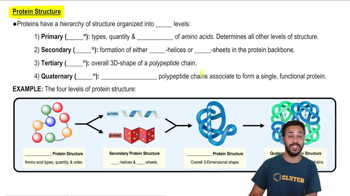
Proteins have four levels of structure: primary, secondary, tertiary, and quaternary. The primary structure is the sequence of amino acids, while the secondary structure refers to local folding patterns like alpha helices and beta sheets. Tertiary structure is the overall 3D shape of a single polypeptide chain, and quaternary structure involves the assembly of multiple polypeptide chains into a functional protein.
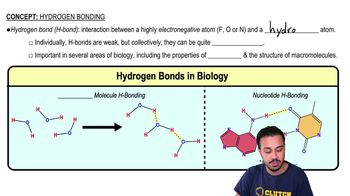
Hydrogen bonds are weak interactions that play a crucial role in stabilizing the secondary and tertiary structures of proteins. They form between polar side chains and contribute to the folding and stability of the protein. Disruption of hydrogen bonds can lead to denaturation, affecting the protein's shape and function, particularly at the secondary and tertiary levels.
The primary structure of a protein, which is the linear sequence of amino acids, is held together by covalent peptide bonds. This structure is the least affected by disruptions in hydrogen bonding, as it does not rely on these interactions for its integrity. Therefore, changes in hydrogen bonding primarily impact higher levels of protein structure, such as secondary and tertiary.

 0:44 minutes
 Verified step by step guidance
 04:53
04:53