Which component is not directly involved in translation?
a. GTP
b. DNA
c. tRNA
d. ribosomes
Verified step by step guidance
1
Identify the process of translation, which is the synthesis of proteins from mRNA.
Understand that translation involves mRNA, tRNA, ribosomes, and various enzymes and factors.
Recognize that GTP is used as an energy source in translation, tRNA brings amino acids, and ribosomes are the site of protein synthesis.
Consider the role of DNA, which is involved in transcription, not translation.
Conclude that DNA is not directly involved in the translation process.
Verified video answer for a similar problem:
This video solution was recommended by our tutors as helpful for the problem above.
Video duration:
24s
Play a video:
0 Comments
Key Concepts
Here are the essential concepts you must grasp in order to answer the question correctly.
Translation
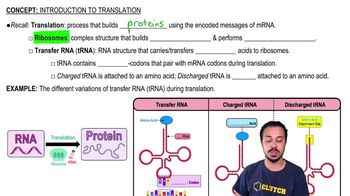
Translation is the process by which ribosomes synthesize proteins using messenger RNA (mRNA) as a template. During this process, transfer RNA (tRNA) molecules bring amino acids to the ribosome, where they are assembled into a polypeptide chain according to the sequence of codons in the mRNA. This is a crucial step in gene expression, converting genetic information into functional proteins.
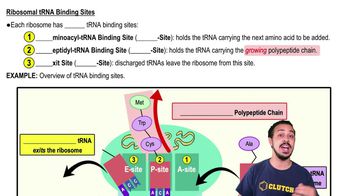
Transfer RNA (tRNA) is a type of RNA that plays a key role in translation by carrying specific amino acids to the ribosome. Each tRNA molecule has an anticodon that pairs with a corresponding codon on the mRNA, ensuring that the correct amino acid is added to the growing polypeptide chain. This specificity is vital for the accurate synthesis of proteins.
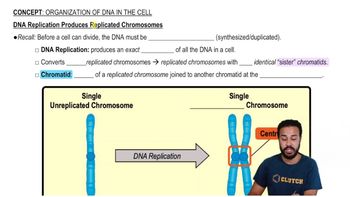
DNA contains the genetic blueprint for all living organisms and is responsible for encoding the information needed to produce proteins. However, DNA itself is not directly involved in the translation process; instead, it is transcribed into mRNA, which then serves as the template for translation. Thus, while DNA is essential for protein synthesis, it does not participate directly in the translation phase.

 0:24 minutes
 Verified step by step guidance
 06:12
06:12