Water .
a. is a good solute;
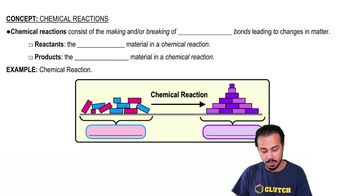
b. facilitates chemical reactions;
c. serves as an enzyme;
d. makes strong covalent bonds with other molecules;
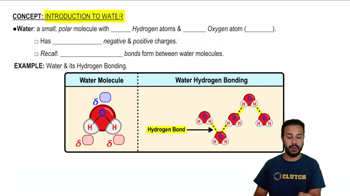
e. consists of two oxygen and one hydrogen atoms
Verified step by step guidance
1
Step 1: Identify the properties of water relevant to the options provided.
Step 2: Analyze each option to determine if it accurately describes a property of water.
Step 3: Consider the chemical structure of water, which is H2O, consisting of two hydrogen atoms and one oxygen atom.
Step 4: Evaluate the role of water in chemical reactions, particularly its ability to act as a solvent and facilitate reactions.
Step 5: Review the nature of water's interactions with other molecules, focusing on hydrogen bonding rather than covalent bonding.
Verified video answer for a similar problem:
This video solution was recommended by our tutors as helpful for the problem above.
Video duration:
1m
Play a video:
0 Comments
Key Concepts
Here are the essential concepts you must grasp in order to answer the question correctly.
Properties of Water
Water is often referred to as a 'universal solvent' due to its ability to dissolve many substances, which is crucial for biological processes. Its polar nature allows it to interact with various ions and molecules, facilitating chemical reactions essential for life.
Water plays a vital role in biochemical reactions, acting as a medium where reactants can collide and interact. It participates in hydrolysis and dehydration synthesis reactions, which are fundamental for metabolism and the formation of macromolecules.
The molecular structure of water consists of two hydrogen atoms covalently bonded to one oxygen atom, forming a bent shape. This unique arrangement contributes to its polar characteristics, leading to hydrogen bonding, which is responsible for many of water's exceptional properties, such as high surface tension and specific heat capacity.

 1:15 minutes
 Verified step by step guidance
 04:07
04:07