A glucose molecule is to starch as (Explain your answer.)a. a steroid is to a lipid.b. a protein is to an amino acid.c. a nucleic acid is to a polypeptide.d. a nucleotide is to a nucleic acid.
Verified step by step guidance
1
Understand the relationship between glucose and starch: Glucose is a monosaccharide, which is a simple sugar, and starch is a polysaccharide, which is a complex carbohydrate made up of many glucose units linked together.
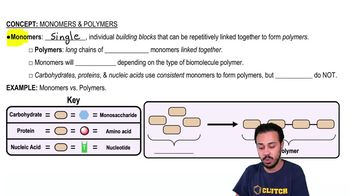
Identify the type of relationship: The relationship between glucose and starch is that of a monomer to a polymer. Glucose is the building block (monomer) that forms the polymer (starch).
Analyze each option to find a similar monomer-polymer relationship: a. A steroid is not a monomer of lipids; lipids are not polymers in the same sense as starch. b. A protein is a polymer made of amino acids, which are the monomers. c. A nucleic acid is a polymer, but a polypeptide is not a monomer; it is a polymer of amino acids. d. A nucleotide is a monomer that makes up nucleic acids, which are polymers.
Compare the relationships: The correct analogy should reflect a monomer-polymer relationship similar to glucose and starch.
Select the correct answer: Based on the analysis, option d (a nucleotide is to a nucleic acid) correctly represents a monomer-polymer relationship similar to glucose and starch.
Verified video answer for a similar problem:
This video solution was recommended by our tutors as helpful for the problem above
Video duration:
1m
Play a video:
Was this helpful?
Key Concepts
Here are the essential concepts you must grasp in order to answer the question correctly.
Monomer and Polymer
A monomer is a small, basic molecular unit that can join together to form larger structures known as polymers. In this context, glucose is a monomer that combines to create starch, which is a polymer made up of many glucose units linked together. Understanding this relationship is crucial for analyzing how smaller molecules can form complex carbohydrates.
Biological macromolecules are large, complex molecules essential for life, including carbohydrates, proteins, lipids, and nucleic acids. Each type of macromolecule has specific functions and structures. Recognizing the role of glucose in carbohydrates and how it compares to other macromolecules helps in understanding the analogy presented in the question.
An analogous relationship compares two pairs of items that have similar functions or structures. In this question, the relationship between glucose and starch is being compared to another pair, requiring an understanding of how the components relate to each other. Identifying the correct analogy involves recognizing the roles of monomers and polymers in different biological macromolecules.