Which of the following is true of unsaturated fats?a. They are more common in animals than in plants.b. They have double bonds in their fatty acid chains.c. They generally solidify at room temperature.d. They contain more hydrogen than do saturated fats having the same number of carbon atoms.
Verified step by step guidance
1
Identify the characteristics of unsaturated fats, focusing on their chemical structure and physical properties.
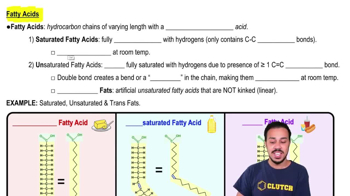
Recall that unsaturated fats have one or more double bonds in their fatty acid chains, which affects their hydrogen content and physical state.
Consider the typical sources of unsaturated fats, noting that they are more commonly found in plants than in animals.
Understand that the presence of double bonds in unsaturated fats prevents them from packing tightly, usually making them liquid at room temperature.
Compare the hydrogen content of unsaturated fats to saturated fats, noting that unsaturated fats have fewer hydrogen atoms due to the presence of double bonds.
Was this helpful?
Key Concepts
Here are the essential concepts you must grasp in order to answer the question correctly.
Unsaturated Fats
Unsaturated fats are types of fatty acids that contain one or more double bonds in their hydrocarbon chains. These double bonds create kinks in the structure, preventing the molecules from packing closely together, which typically results in a liquid state at room temperature. They are primarily found in plant oils, nuts, and fish.
Saturated fats have no double bonds between carbon atoms, allowing them to be fully saturated with hydrogen atoms. This structure leads to a straight chain that can pack tightly, making them solid at room temperature. In contrast, unsaturated fats, with their double bonds, are usually liquid at room temperature and are considered healthier for heart health.
The physical state of fats at room temperature is influenced by their saturation level. Unsaturated fats tend to remain liquid due to their molecular structure, while saturated fats are solid. This property is important in nutrition and cooking, as it affects the texture and health implications of dietary fats.