What makes a fatty acid an acid?
a. It does not dissolve in water.
b. It is capable of bonding with other molecules to form a fat.
c. It has a carboxyl group that can donate an H+ to a solution.
d. It contains only two oxygen atoms.
Verified step by step guidance
1
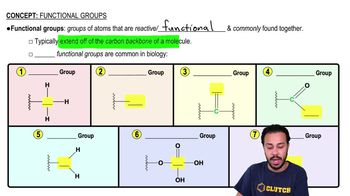
Identify the functional group present in a fatty acid that is responsible for its acidic properties.
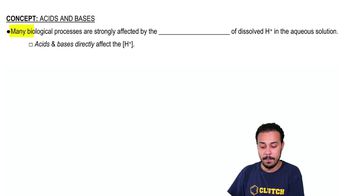
Recall that an acid is a substance that can donate a proton (H+) to a solution.
Consider the structure of a fatty acid, which typically includes a long hydrocarbon chain and a carboxyl group (-COOH) at one end.
Understand that the carboxyl group is capable of donating an H+ ion, making the molecule an acid.
Conclude that the presence of the carboxyl group, which can donate an H+ to a solution, is what makes a fatty acid an acid.
Verified video answer for a similar problem:
This video solution was recommended by our tutors as helpful for the problem above.
Video duration:
2m
Play a video:
0 Comments
Key Concepts
Here are the essential concepts you must grasp in order to answer the question correctly.
Fatty Acids
Fatty acids are long hydrocarbon chains with a carboxyl group (-COOH) at one end. They are key components of lipids and can be saturated or unsaturated, depending on the presence of double bonds between carbon atoms. Their structure influences their physical properties and biological functions.
The carboxyl group is a functional group characterized by a carbon atom double-bonded to an oxygen atom and single-bonded to a hydroxyl group (-OH). This group is responsible for the acidic properties of fatty acids, as it can donate a hydrogen ion (H+) to a solution, thus acting as an acid.
Acid-base chemistry involves the transfer of protons (H+) between molecules. In this context, a substance that can donate protons is classified as an acid. The ability of fatty acids to release H+ ions due to their carboxyl group is what categorizes them as acids in chemical terms.

 2:12 minutes
 Verified step by step guidance
 11:34
11:34