Ch. 2 The Chemical Level of Organization
Martini - Fundamentals of Anatomy & Physiology 11th Edition
Martini, Nath, Bartholomew11th EditionFundamentals of Anatomy & PhysiologyISBN: 9780136874089Not the one you use?Change textbook
Chapter 2, Problem 20a

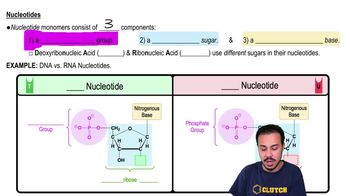
a. What three basic components make up a nucleotide of DNA?

Verified step by step guidance
1
Understand that a nucleotide is the basic building block of DNA, and each nucleotide consists of three fundamental components.
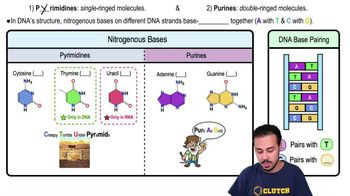
Identify the first component: a nitrogenous base, which can be one of four types in DNA—adenine (A), thymine (T), cytosine (C), or guanine (G).
Identify the second component: a five-carbon sugar called deoxyribose, which forms the backbone of the DNA strand.
Identify the third component: a phosphate group, which links the sugar of one nucleotide to the sugar of the next nucleotide, creating the sugar-phosphate backbone.
Summarize that these three components—nitrogenous base, deoxyribose sugar, and phosphate group—together form a nucleotide in DNA.

Verified video answer for a similar problem:

This video solution was recommended by our tutors as helpful for the problem above.
Video duration:
3m
Was this helpful?

Key Concepts

Here are the essential concepts you must grasp in order to answer the question correctly.

Nucleotide Structure

A nucleotide is the basic building block of DNA, composed of three main parts: a nitrogenous base, a five-carbon sugar, and a phosphate group. These components combine to form the repeating units of the DNA strand.
Recommended video:
05:35
Nucleotides

Nitrogenous Bases

Nitrogenous bases are molecules that contain nitrogen and act as the information carriers in DNA. The four types in DNA are adenine, thymine, cytosine, and guanine, which pair specifically to encode genetic information.
Recommended video:
07:21
5 Nitrogenous Bases

Deoxyribose Sugar

Deoxyribose is the five-carbon sugar in DNA nucleotides that connects the nitrogenous base to the phosphate group. It differs from ribose by lacking one oxygen atom, which is crucial for the stability and structure of DNA.
Recommended video:
05:35
Nucleotides