
Textbook Question
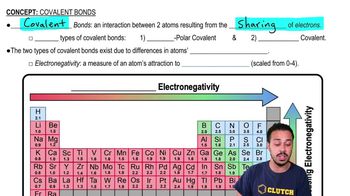
Explain the difference between an ionic and a covalent bond.
1397
views

 Verified step by step guidance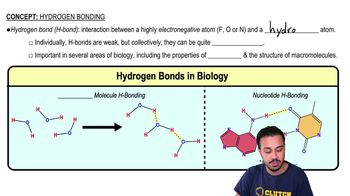
 05:03
05:03
 04:28
04:28 8:47
8:47Explain the difference between an ionic and a covalent bond.
Identify each of the following molecules or compounds as ionic, polar covalent, or nonpolar covalent.
a. H2O _________
b. LiI _________
c. C10H22 _________
d. N2 _________
e. MgBr2 _________
f. H2S _________
Which of the following would not result in an increase in reaction rate?
a. Increase in temperature
b. Particles in the solid phase
c. Presence of a catalyst
d. Smaller particle size
Describe what takes place during a chemical reaction.
Some claim that the pH of your blood can be affected by eating acidic foods such as citrus. Do you believe this to be true? Explain your answer. (Hint: What happens when extra hydrogen ions are added to the blood?)
Match the following terms with the correct definition:
Endergonic reaction
Potential energy
Electrical energy
Anabolic reaction
Oxidation-reduction reaction
Chemical energy
Catabolic reaction
Kinetic energy
a. Energy in motion
b. Energy stored in chemical bonds
c. Reaction that consumes energy
d. A decomposition reaction
e. The energy of moving charged particles
f. Stored energy
g. Synthesis reaction
h. Reaction where electrons are transferred between reactants