What is the hydroxide ion concentration of the lake described in question 3?
a. 10−10M
b. 10−4M
c. 10−7M
d. 10.0 M
Verified step by step guidance
1
Identify the pH of the lake from question 3, as it is necessary to find the hydroxide ion concentration.
Recall the relationship between pH and pOH: \( \text{pH} + \text{pOH} = 14 \).
Calculate the pOH by subtracting the pH from 14.
Use the formula \( [\text{OH}^-] = 10^{-\text{pOH}} \) to find the hydroxide ion concentration.
Compare the calculated hydroxide ion concentration with the given options to determine the correct answer.
Verified video answer for a similar problem:
This video solution was recommended by our tutors as helpful for the problem above.
Video duration:
2m
Play a video:
0 Comments
Key Concepts
Here are the essential concepts you must grasp in order to answer the question correctly.
Hydroxide Ion Concentration
Hydroxide ion concentration ([OH⁻]) refers to the amount of hydroxide ions present in a solution, typically measured in moles per liter (M). It is crucial for determining the pH of a solution, as pH and pOH are related through the equation pH + pOH = 14 at 25°C. Understanding this concept is essential for calculating the concentration of hydroxide ions in the lake.
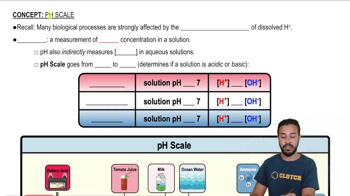
The pH scale measures the acidity or basicity of a solution, with lower values indicating higher acidity and higher values indicating higher basicity. The pOH scale is similarly defined for hydroxide ion concentration. The relationship between pH and pOH is fundamental in chemistry, as it allows for the conversion between the two, which is necessary for solving problems related to ion concentrations in solutions.
The water ion product (Kw) is the equilibrium constant for the self-ionization of water, defined as Kw = [H⁺][OH⁻] = 1.0 x 10⁻¹⁴ at 25°C. This constant is vital for calculating hydroxide ion concentration when the hydrogen ion concentration is known. It provides a foundational understanding of how the concentrations of H⁺ and OH⁻ ions interact in aqueous solutions, particularly in neutral, acidic, or basic environments.

 2:21 minutes
 Verified step by step guidance
 03:35
03:35