Where does the citric acid cycle occur in eukaryotes?
a. in the cytosol of cells
b. in the intermembrane space of mitochondria
c. in the inner membrane of mitochondria
d. in the matrix of mitochondria
Verified step by step guidance
1
Identify the location of the citric acid cycle within the cell.
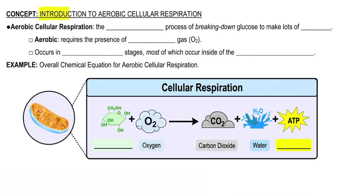
Recall that the citric acid cycle is a key metabolic pathway that completes the breakdown of glucose derivatives.
Understand that the citric acid cycle occurs in a specific part of the mitochondria in eukaryotic cells.
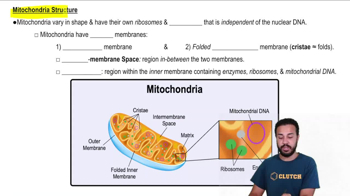
Consider the structure of the mitochondria, which includes the outer membrane, intermembrane space, inner membrane, and matrix.
Determine that the citric acid cycle takes place in the matrix of the mitochondria, where enzymes and substrates are available for the cycle's reactions.
Verified video answer for a similar problem:
This video solution was recommended by our tutors as helpful for the problem above.
Video duration:
1m
Play a video:
0 Comments
Key Concepts
Here are the essential concepts you must grasp in order to answer the question correctly.
Citric Acid Cycle Location
The citric acid cycle, also known as the Krebs cycle, occurs in the matrix of mitochondria in eukaryotic cells. This is the innermost compartment of the mitochondria, where enzymes and substrates necessary for the cycle are present, allowing for efficient energy production through the oxidation of acetyl-CoA.
Mitochondria have a double-membrane structure consisting of an outer membrane and an inner membrane, which encloses the matrix. The inner membrane is highly folded into structures called cristae, increasing surface area for biochemical reactions, while the matrix contains enzymes for the citric acid cycle and other metabolic processes.
In eukaryotes, cellular respiration involves multiple stages, including glycolysis, the citric acid cycle, and oxidative phosphorylation. The citric acid cycle plays a crucial role in breaking down carbohydrates, fats, and proteins to produce ATP, NADH, and FADH2, which are essential for energy transfer within the cell.

 1:55 minutes
 Verified step by step guidance
 01:37
01:37