A friend says, 'Geneticists spend all their time talking about DNA, but that's silly because DNA really isn't that important in the functions of a cell.' In what ways is she right, and in what ways might she be wrong?
Verified step by step guidance
1
insert step 1: Begin by explaining the role of DNA in the cell. DNA, or deoxyribonucleic acid, is the hereditary material in humans and almost all other organisms. It contains the instructions needed for an organism to develop, survive, and reproduce.
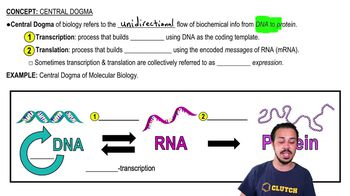
insert step 2: Discuss how DNA is crucial for protein synthesis. DNA sequences are transcribed into mRNA, which is then translated into proteins. Proteins are essential for most cellular functions, including structure, function, and regulation of the body's tissues and organs.
insert step 3: Highlight the importance of DNA in cell replication. During cell division, DNA must be replicated so that each new cell receives a complete set of genetic instructions. This is vital for growth, repair, and reproduction.
insert step 4: Consider the argument that DNA is not directly involved in all cellular functions. While DNA provides the instructions, it is the proteins and other molecules that carry out the actual work within the cell.
insert step 5: Conclude by acknowledging that while DNA is not directly involved in every cellular process, it is fundamentally important as it provides the blueprint for all cellular activities. Without DNA, cells would not have the necessary instructions to function properly.
Was this helpful?
Key Concepts
Here are the essential concepts you must grasp in order to answer the question correctly.
Role of DNA in Cellular Function
DNA serves as the blueprint for all cellular functions, encoding the instructions for synthesizing proteins, which are essential for cell structure and function. While DNA is crucial, it is not the sole determinant of cellular behavior, as other factors like RNA and proteins also play significant roles.
Gene expression regulation is the process by which cells control the amount and timing of protein production. This regulation is influenced by various factors, including environmental signals and epigenetic modifications, indicating that DNA alone does not dictate cellular functions without these regulatory mechanisms.
The Central Dogma describes the flow of genetic information from DNA to RNA to protein. This framework highlights that while DNA is important, the processes of transcription and translation are equally vital for cellular function, emphasizing that cellular activities depend on a complex interplay of molecules beyond just DNA.