Check your understanding of the flow of genetic information through a cell by filling in the blanks.
a.
b.
c.
d.
e.
f.
g.
h.
i.
Verified step by step guidance
1
Identify the monomers that make up DNA, which are nucleotides.
Determine the process by which DNA is transcribed into RNA, which is transcription.
Identify the enzyme responsible for transcription, which is RNA polymerase.
List the three types of RNA: mRNA (messenger RNA), tRNA (transfer RNA), and rRNA (ribosomal RNA).
Identify the process by which RNA is translated into protein, which is translation.
Verified video answer for a similar problem:
This video solution was recommended by our tutors as helpful for the problem above.
Video duration:
1m
Play a video:
0 Comments
Key Concepts
Here are the essential concepts you must grasp in order to answer the question correctly.
DNA Structure and Function
DNA, or deoxyribonucleic acid, is a polymer composed of nucleotide monomers. Each nucleotide consists of a sugar, a phosphate group, and a nitrogenous base. DNA serves as the genetic blueprint for living organisms, encoding the instructions necessary for the development, functioning, and reproduction of cells.
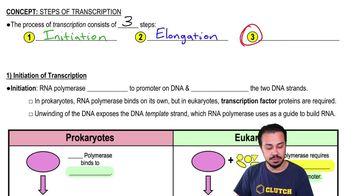
Transcription is the process by which the genetic information in DNA is copied into messenger RNA (mRNA). This process is facilitated by the enzyme RNA polymerase, which synthesizes RNA by reading the DNA template. Transcription is a crucial step in gene expression, allowing the information in DNA to be translated into functional proteins.
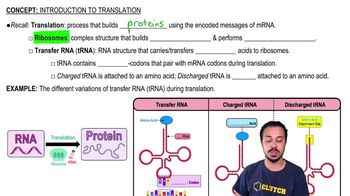
Translation is the process by which the sequence of nucleotides in mRNA is decoded to synthesize proteins. This occurs in ribosomes, which are complex structures made of ribosomal RNA (rRNA) and proteins. During translation, transfer RNA (tRNA) molecules bring amino acids to the ribosome, where they are assembled into polypeptide chains, forming proteins that perform various functions in the cell.

 1:16 minutes
 Verified step by step guidance
 03:20
03:20