Which of the following describes the experimental strategy that was used to decipher the genetic code?a. comparing the amino acid sequences of proteins with the base sequence of their genesb. analyzing the sequence of RNAs produced from known DNA sequencesc. analyzing mutants that changed the coded. examining the polypeptides produced when RNAs with particular sequences were translated
Verified step by step guidance
1
Identify the main goal of the experimental strategy, which is to decipher the genetic code.
Consider the process of translation, where RNA sequences are used to synthesize polypeptides.
Evaluate each option to determine which one directly involves translating RNA sequences into polypeptides.
Option a involves comparing amino acid sequences with gene sequences, which is more about correlation than direct translation.
Option d involves examining polypeptides produced from specific RNA sequences, which directly tests the translation process and helps decipher the genetic code.
Was this helpful?
Key Concepts
Here are the essential concepts you must grasp in order to answer the question correctly.
Genetic Code
The genetic code is the set of rules by which information encoded in genetic material (DNA or RNA) is translated into proteins. It consists of codons, which are sequences of three nucleotides that correspond to specific amino acids. Understanding the genetic code is essential for deciphering how genes dictate the synthesis of proteins, which are crucial for cellular functions.
Experimental strategies in genetics involve various methods used to investigate the relationship between genes and their expression. Techniques such as comparing amino acid sequences with DNA sequences, analyzing RNA products, and studying mutants provide insights into how genetic information is translated into functional proteins. These strategies are fundamental for understanding genetic mechanisms and the role of mutations.
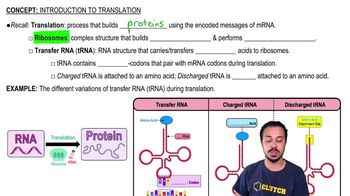
Translation is the process by which ribosomes synthesize proteins using messenger RNA (mRNA) as a template. During translation, the sequence of nucleotides in mRNA is read in sets of three (codons), each corresponding to a specific amino acid. This process is crucial for understanding how genetic information is expressed and how variations in the genetic code can affect protein function.