Which of the following is not true of a codon?a. It may code for the same amino acid as another codon.b. It never codes for more than one amino acid.c. It extends from one end of a tRNA molecule.d. It is the basic unit of the genetic code.
Verified step by step guidance
1
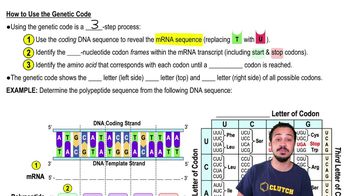
Identify the definition of a codon: A codon is a sequence of three nucleotides that together form a unit of genetic code in a DNA or RNA molecule.
Understand that each codon corresponds to a specific amino acid or a stop signal during protein synthesis.
Review the options given: a) Codons can code for the same amino acid due to the redundancy of the genetic code. b) Each codon specifies only one amino acid or a stop signal, not multiple amino acids. c) Codons are part of mRNA, not tRNA. d) Codons are indeed the basic units of the genetic code.
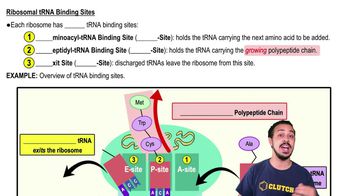
Analyze option c: A codon does not extend from one end of a tRNA molecule; instead, the anticodon is the part of tRNA that pairs with the codon on mRNA.
Conclude that option c is not true of a codon, as codons are associated with mRNA, not tRNA.
Was this helpful?
Key Concepts
Here are the essential concepts you must grasp in order to answer the question correctly.
Codon Definition
A codon is a sequence of three nucleotides in mRNA that specifies a particular amino acid during protein synthesis. Each codon corresponds to one of the 20 amino acids or serves as a stop signal, making it a fundamental unit of the genetic code.
The genetic code is described as degenerate because multiple codons can code for the same amino acid. This redundancy helps to minimize the impact of mutations, as a change in one nucleotide may not necessarily alter the resulting protein.
Transfer RNA (tRNA) molecules have anticodons that are complementary to codons on mRNA. This interaction is crucial for the accurate translation of the genetic code into proteins, as each tRNA carries a specific amino acid that corresponds to its anticodon.