List the order of nucleotides on the mRNA that would be transcribed from the following DNA sequence: CGATTACTTA.
Verified step by step guidance
1
Identify the DNA sequence provided: CGATTACTTA.
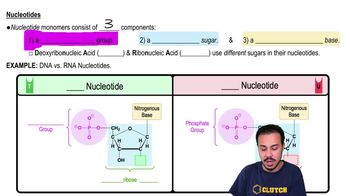
Recall that during transcription, DNA is used as a template to synthesize mRNA, where adenine (A) pairs with uracil (U), thymine (T) pairs with adenine (A), cytosine (C) pairs with guanine (G), and guanine (G) pairs with cytosine (C).
Transcribe each nucleotide from the DNA template to its complementary mRNA nucleotide: C -> G, G -> C, A -> U, T -> A, T -> A, A -> U, C -> G, T -> A, T -> A, A -> U.
Write down the resulting mRNA sequence using the complementary nucleotides identified in the previous step.
Review the mRNA sequence to ensure that each DNA nucleotide has been correctly transcribed to its complementary mRNA nucleotide.
Verified video answer for a similar problem:
This video solution was recommended by our tutors as helpful for the problem above.
Video duration:
5m
Play a video:
0 Comments
Key Concepts
Here are the essential concepts you must grasp in order to answer the question correctly.
Transcription
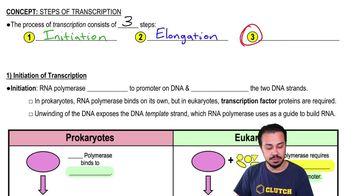
Transcription is the process by which the genetic information encoded in DNA is copied into messenger RNA (mRNA). During transcription, RNA polymerase binds to the DNA at a specific region called the promoter and synthesizes a complementary RNA strand using one of the DNA strands as a template.
Nucleotide base pairing refers to the specific pairing of nitrogenous bases in nucleic acids. In DNA, adenine (A) pairs with thymine (T), and cytosine (C) pairs with guanine (G). During transcription, however, uracil (U) replaces thymine in RNA, so adenine pairs with uracil instead.
The mRNA sequence is formed by complementary base pairing to the DNA template strand during transcription. For each DNA nucleotide, a corresponding RNA nucleotide is added to the growing mRNA strand, resulting in a sequence that reflects the original DNA sequence, with the exception of uracil replacing thymine.

 5:29 minutes
 Verified step by step guidance
 04:16
04:16