Which of the following correctly ranks the structures in order of size, from largest to smallest?
a. gene-chromosome-nucleotide-codon
b. chromosome-gene-codon-nucleotide
c. nucleotide-chromosome-gene-codon
d. chromosome-nucleotide-gene-codon
Verified step by step guidance
1
Identify the structures involved: chromosome, gene, nucleotide, and codon.
Understand the hierarchy of genetic structures: Chromosomes are made up of genes, which are sequences of nucleotides.
Recognize that a codon is a sequence of three nucleotides that corresponds to a specific amino acid or stop signal during protein synthesis.
Rank the structures from largest to smallest based on their definitions: Chromosome > Gene > Codon > Nucleotide.
Compare the options given in the problem to determine which one matches the correct order of size.
Verified video answer for a similar problem:
This video solution was recommended by our tutors as helpful for the problem above.
Video duration:
1m
Play a video:
0 Comments
Key Concepts
Here are the essential concepts you must grasp in order to answer the question correctly.
Chromosome
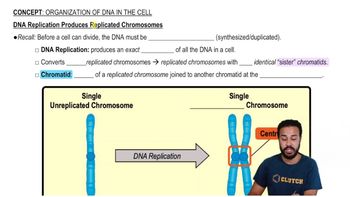
A chromosome is a long, thread-like structure made of DNA and proteins that contains genetic information. In humans, chromosomes are found in the nucleus of cells and are organized into pairs. Each chromosome can contain hundreds to thousands of genes, making it one of the largest structures in the hierarchy of genetic organization.
A gene is a specific sequence of DNA that encodes instructions for building proteins, which are essential for the structure and function of living organisms. Genes are located on chromosomes and can vary in size, but they are generally much smaller than chromosomes. Each gene plays a crucial role in determining an organism's traits and characteristics.
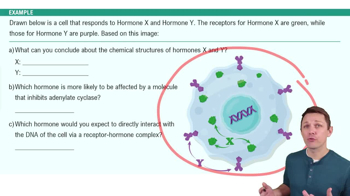
Intracellular Receptors and Direct Gene Action Example 1
Nucleotide and Codon
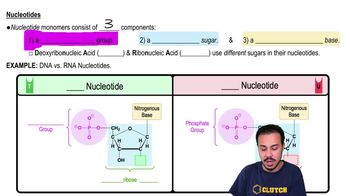
Nucleotides are the basic building blocks of DNA and RNA, consisting of a sugar, a phosphate group, and a nitrogenous base. A codon is a sequence of three nucleotides that corresponds to a specific amino acid or stop signal during protein synthesis. Codons are smaller than nucleotides, as they are formed by combinations of three nucleotides, making them one of the smallest units in the genetic hierarchy.

 1:39 minutes
 Verified step by step guidance
 05:13
05:13