Draw a hypothetical metabolic pathway in Neurospora crassa composed of five substrates, five enzymes, and a product called nirvana. Number the substrates 1–5, and label the enzymes A–E, in order. (For instance, enzyme A catalyzes the reaction between substrates 1 and 2.) (b) Suppose a mutant strain can survive if substrate 5 is added to the growth medium, but it cannot grow if substrates 1, 2, 3, or 4 are added. Which enzyme in the pathway is affected in this mutant?
Verified step by step guidance
1
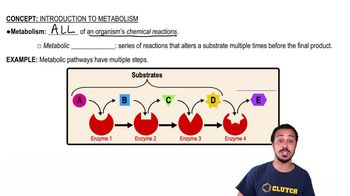
Step 1: Understand the metabolic pathway concept. A metabolic pathway is a series of chemical reactions occurring within a cell, where the product of one reaction serves as the substrate for the next.
Step 2: Visualize the pathway. Draw a sequence of substrates labeled 1 to 5, with enzymes A to E catalyzing the reactions between each pair of substrates. For example, enzyme A catalyzes the reaction from substrate 1 to substrate 2.
Step 3: Analyze the mutant strain's condition. The mutant can survive with substrate 5 but not with substrates 1, 2, 3, or 4. This suggests that the pathway is blocked before substrate 5.
Step 4: Determine the point of blockage. Since the mutant can survive with substrate 5, the blockage must occur at the step just before substrate 5 is produced, which is the reaction catalyzed by enzyme E.
Step 5: Conclude which enzyme is affected. The inability to grow with substrates 1, 2, 3, or 4 indicates that enzyme E is non-functional in the mutant, preventing the conversion of substrate 4 to substrate 5.
Was this helpful?
Key Concepts
Here are the essential concepts you must grasp in order to answer the question correctly.
Metabolic Pathway
A metabolic pathway is a series of chemical reactions occurring within a cell, where substrates are converted into products through the action of enzymes. Each step in the pathway is catalyzed by a specific enzyme, which facilitates the transformation of substrates into intermediate compounds and ultimately into the final product. Understanding the flow of substrates and the role of enzymes is crucial for analyzing how metabolic processes function and how they can be disrupted in mutant strains.
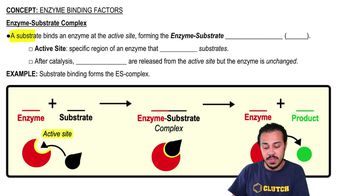
Enzymes are biological catalysts that speed up chemical reactions by lowering the activation energy required for the reaction to occur. In the context of mutations, a change in the enzyme's structure can lead to a loss of function or altered activity, affecting the metabolic pathway. In this scenario, identifying which enzyme is affected by the mutation involves understanding the specific role of each enzyme in the pathway and how the absence of certain substrates impacts the overall metabolic function.
Substrate specificity refers to the ability of an enzyme to selectively catalyze a reaction for a particular substrate or group of substrates. In metabolic pathways, each enzyme typically acts on specific substrates to produce specific products. In the case of the mutant strain that can only survive with substrate 5, it suggests that the enzyme responsible for converting substrates 1-4 is non-functional, indicating that the affected enzyme is likely one that acts on these initial substrates, thus disrupting the pathway's progression.