Draw a hypothetical metabolic pathway in Neurospora crassa composed of five substrates, five enzymes, and a product called nirvana. Number the substrates 1–5, and label the enzymes A–E, in order. (For instance, enzyme A catalyzes the reaction between substrates 1 and 2.) (b) Suppose a mutant strain can survive if substrate 5 is added to the growth medium, but it cannot grow if substrates 1, 2, 3, or 4 are added. Which enzyme in the pathway is affected in this mutant?
Verified step by step guidance
1
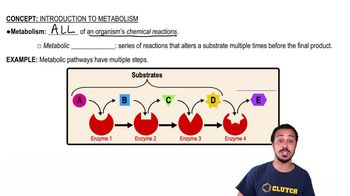
Step 1: Draw a linear metabolic pathway with five substrates labeled as S1, S2, S3, S4, and S5.
Step 2: Label the enzymes that catalyze the reactions between these substrates as A, B, C, D, and E, respectively. For example, enzyme A catalyzes the conversion of S1 to S2.
Step 3: Identify the final product of the pathway as 'nirvana', which is produced from substrate S5 by enzyme E.
Step 4: Analyze the mutant strain's condition: it can survive with S5 but not with S1, S2, S3, or S4. This suggests that the pathway is blocked before S5.
Step 5: Determine that the enzyme responsible for converting S4 to S5 (enzyme D) is likely affected in the mutant, as adding S5 allows growth, bypassing the need for enzyme D.
Was this helpful?
Key Concepts
Here are the essential concepts you must grasp in order to answer the question correctly.
Metabolic Pathway
A metabolic pathway is a series of chemical reactions occurring within a cell, where substrates are converted into products through the action of enzymes. Each step in the pathway is catalyzed by a specific enzyme, which facilitates the transformation of substrates into intermediate compounds and ultimately into the final product. Understanding the flow of substrates and the role of enzymes is crucial for analyzing how metabolic processes function and how they can be disrupted in mutant strains.
Enzymes are biological catalysts that speed up chemical reactions by lowering the activation energy required for the reaction to occur. Each enzyme is specific to a particular substrate or group of substrates, meaning that it will only catalyze reactions involving those specific molecules. In the context of the question, identifying which enzyme is affected in the mutant strain requires understanding the specific substrates that the enzyme acts upon and how the absence of those substrates impacts the overall metabolic pathway.
A mutant strain refers to an organism that has undergone a genetic change, resulting in altered traits or functions compared to the wild type. In metabolic studies, analyzing mutant strains can reveal insights into the roles of specific enzymes and substrates in metabolic pathways. In this case, the mutant strain's ability to survive only with substrate 5 suggests that the enzyme responsible for catalyzing the reactions involving substrates 1-4 is non-functional, highlighting the importance of that enzyme in the pathway.