Ch. 1 The Human Body: An Orientation
Marieb - Essentials of Human Anatomy & Physiology 13th Edition
Marieb13th EditionEssentials of Human Anatomy & PhysiologyISBN: 9780135624340Not the one you use?Change textbook
Chapter 1, Problem 3

Using the terms listed below, fill in the blank with the proper term.
Anterior
Superior
Medial
Proximal
Superficial
posterior
Inferior
Lateral
Distal
Deep
The heart is located__________to the diaphragm.
The muscles are____________to the bone.
The shoulder is_____________to the elbow.
In anatomical position, the thumb is__________to the index finger.
The vertebral region is_____________to the scapular region.
The gluteal region is located on the____________surface of the body.

Verified step by step guidance
1
Step 1: Understand the anatomical terms provided in the problem. These terms describe the relative positions of body parts. For example, 'anterior' means toward the front, 'posterior' means toward the back, 'superior' means above, 'inferior' means below, 'medial' means toward the midline, 'lateral' means away from the midline, 'proximal' means closer to the point of attachment, 'distal' means farther from the point of attachment, 'superficial' means closer to the surface, and 'deep' means farther from the surface.
Step 2: Analyze the first sentence: 'The heart is located__________to the diaphragm.' The heart is positioned above the diaphragm in the thoracic cavity. Use the term that means 'above' to fill in the blank.
Step 3: Analyze the second sentence: 'The muscles are____________to the bone.' Muscles are located closer to the surface of the body compared to bones. Use the term that means 'closer to the surface' to fill in the blank.
Step 4: Analyze the third sentence: 'The shoulder is_____________to the elbow.' The shoulder is closer to the trunk of the body compared to the elbow. Use the term that means 'closer to the point of attachment' to fill in the blank.
Step 5: Continue analyzing the remaining sentences in the same way, using the definitions of the anatomical terms to determine the correct word for each blank. For example, consider the relative positions of the thumb and index finger, the vertebral and scapular regions, and the gluteal region in relation to the body surface.

Verified video answer for a similar problem:

This video solution was recommended by our tutors as helpful for the problem above.
Video duration:
4m
Was this helpful?

Key Concepts

Here are the essential concepts you must grasp in order to answer the question correctly.

Anatomical Directional Terms

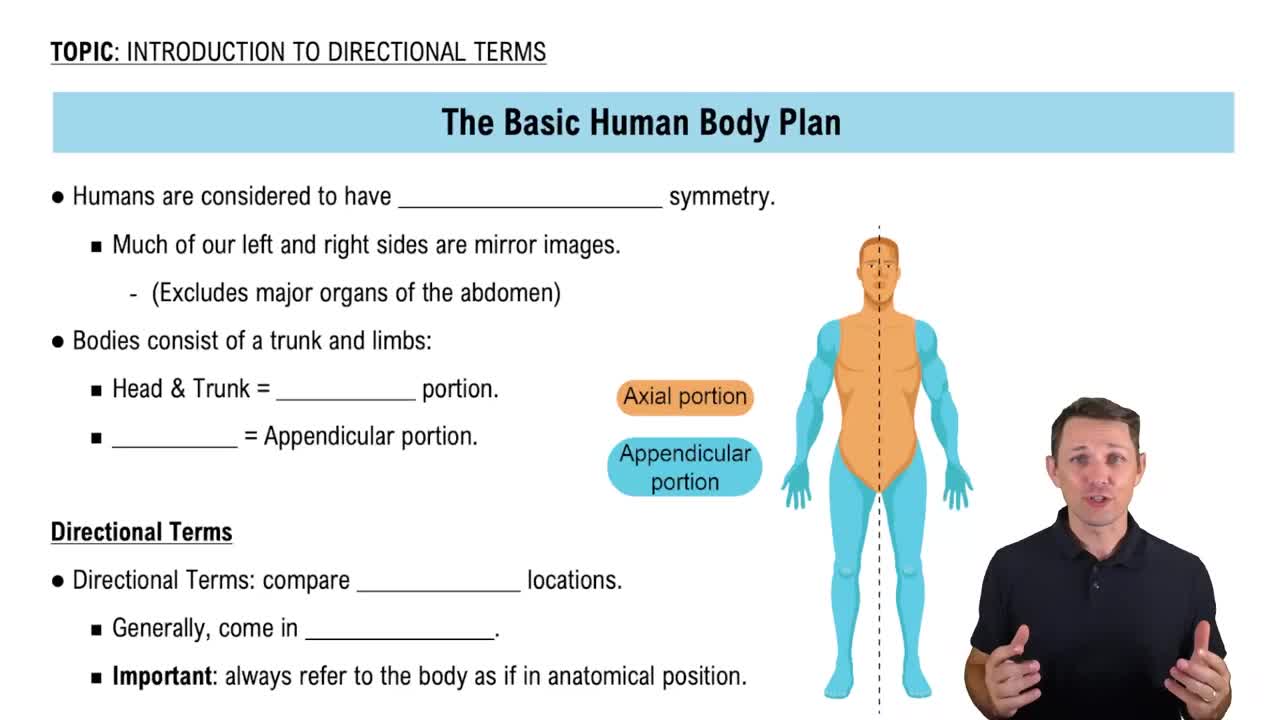
Anatomical directional terms are standardized terms used to describe the locations of structures in relation to one another in the body. These terms include anterior (front), posterior (back), superior (above), inferior (below), medial (toward the midline), lateral (away from the midline), proximal (closer to the point of attachment), distal (farther from the point of attachment), superficial (closer to the surface), and deep (further from the surface). Understanding these terms is essential for accurately describing the positions of organs and structures.
Recommended video:
Guided course
03:00
Introduction to Directional Terms

Anatomical Position

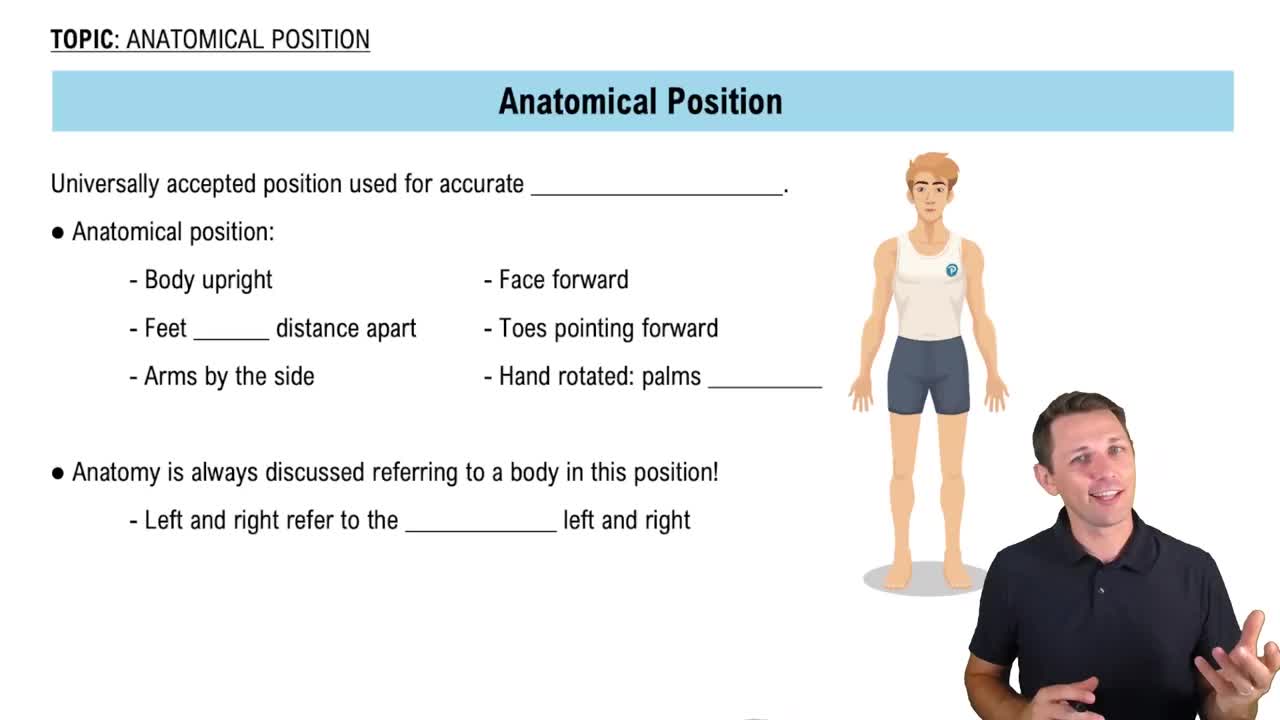
The anatomical position is a standardized stance used in anatomy to ensure clarity when describing the location of body parts. In this position, a person stands upright, facing forward, with arms at the sides and palms facing forward. This position serves as a reference point for using directional terms, allowing for consistent communication about the body's structure and orientation.
Recommended video:
Guided course
02:40
Anatomical Position

Body Regions

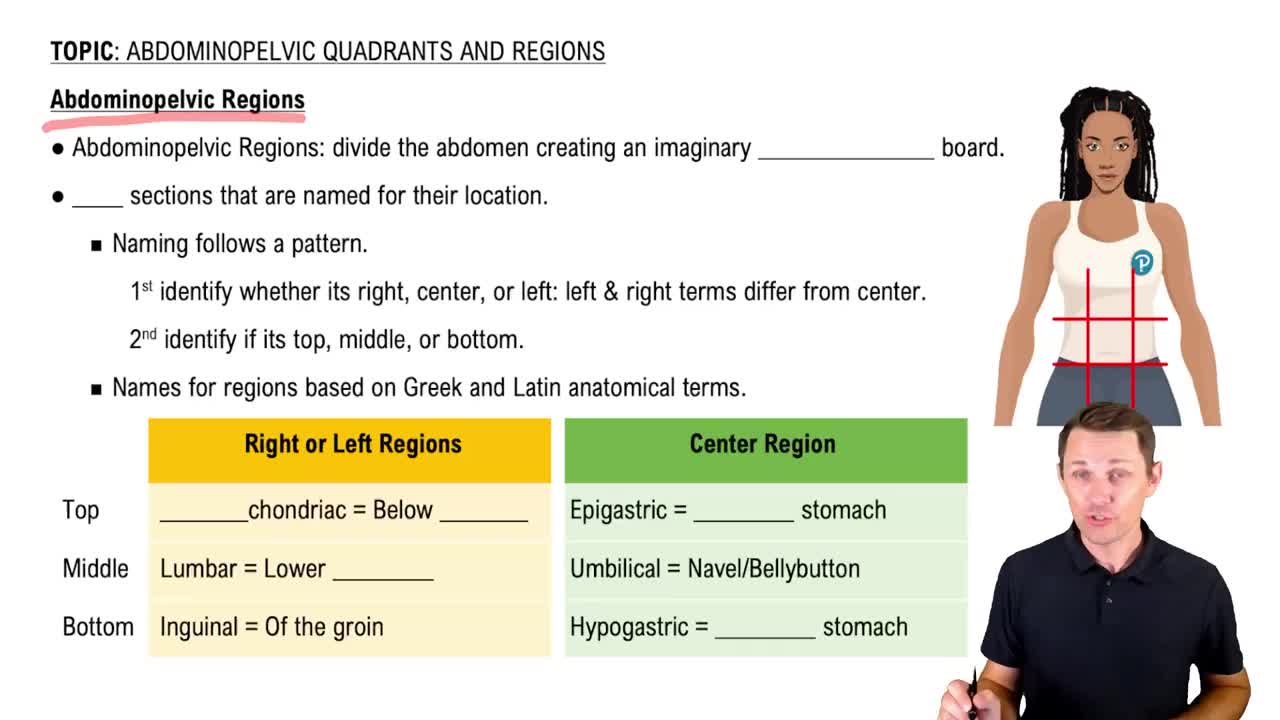
Body regions refer to specific areas of the body that are often used to describe the location of organs and structures. Common regions include the gluteal region (buttocks), scapular region (shoulder blades), and vertebral region (spine). Understanding these regions helps in identifying where certain anatomical features are located and facilitates effective communication in medical and anatomical contexts.
Recommended video:
Guided course
04:21
The 9 Abdominopelvic Regions