
Ch. 3 The Cellular Level of Organization
Martini - Fundamentals of Anatomy & Physiology 11th Edition
Martini, Nath, Bartholomew11th EditionFundamentals of Anatomy & PhysiologyISBN: 9780136874089Not the one you use?Change textbook
Chapter 3, Problem 7

The synthesis of a functional polypeptide using the information in an mRNA strand is
(a) Translation
(b) Transcription
(c) Replication
(d) Gene activation

Verified step by step guidance
1
Understand the central dogma of molecular biology, which describes the flow of genetic information from DNA to RNA to protein.
Recall that transcription is the process where DNA is used as a template to synthesize messenger RNA (mRNA).
Recognize that translation is the process where the information in the mRNA strand is used to assemble amino acids into a polypeptide chain (protein).
Identify that replication refers to the copying of DNA to produce identical DNA molecules, not protein synthesis.
Conclude that the synthesis of a functional polypeptide from mRNA is called translation.

Verified video answer for a similar problem:

This video solution was recommended by our tutors as helpful for the problem above.
Video duration:
2m
Was this helpful?

Key Concepts

Here are the essential concepts you must grasp in order to answer the question correctly.

Translation

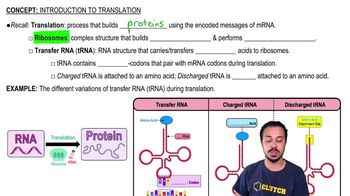
Translation is the process by which the genetic code carried by mRNA is decoded to produce a specific polypeptide or protein. It occurs in the ribosome, where tRNA molecules bring amino acids that are linked together in the order specified by the mRNA sequence.
Recommended video:
06:12
Introduction to Translation

Transcription

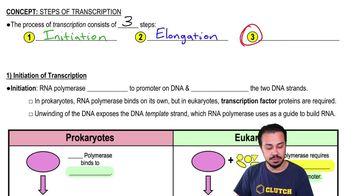
Transcription is the synthesis of an RNA strand from a DNA template. During this process, the DNA sequence of a gene is copied into mRNA, which then carries the genetic information needed for protein synthesis.
Recommended video:
04:16
1) Initiation of Transcription

Replication

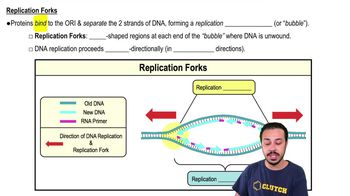
Replication is the process of copying the entire DNA molecule to produce two identical DNA strands. This is essential for cell division but does not involve the synthesis of proteins or polypeptides.
Recommended video:
04:
Replication Forks