Ch. 1 An Introduction to Anatomy and Physiology
Martini - Fundamentals of Anatomy & Physiology 11th Edition
Martini, Nath, Bartholomew11th EditionFundamentals of Anatomy & PhysiologyISBN: 9780136874089Not the one you use?Change textbook
Chapter 1, Problem 28

Describe the anatomical position.

Verified step by step guidance
1
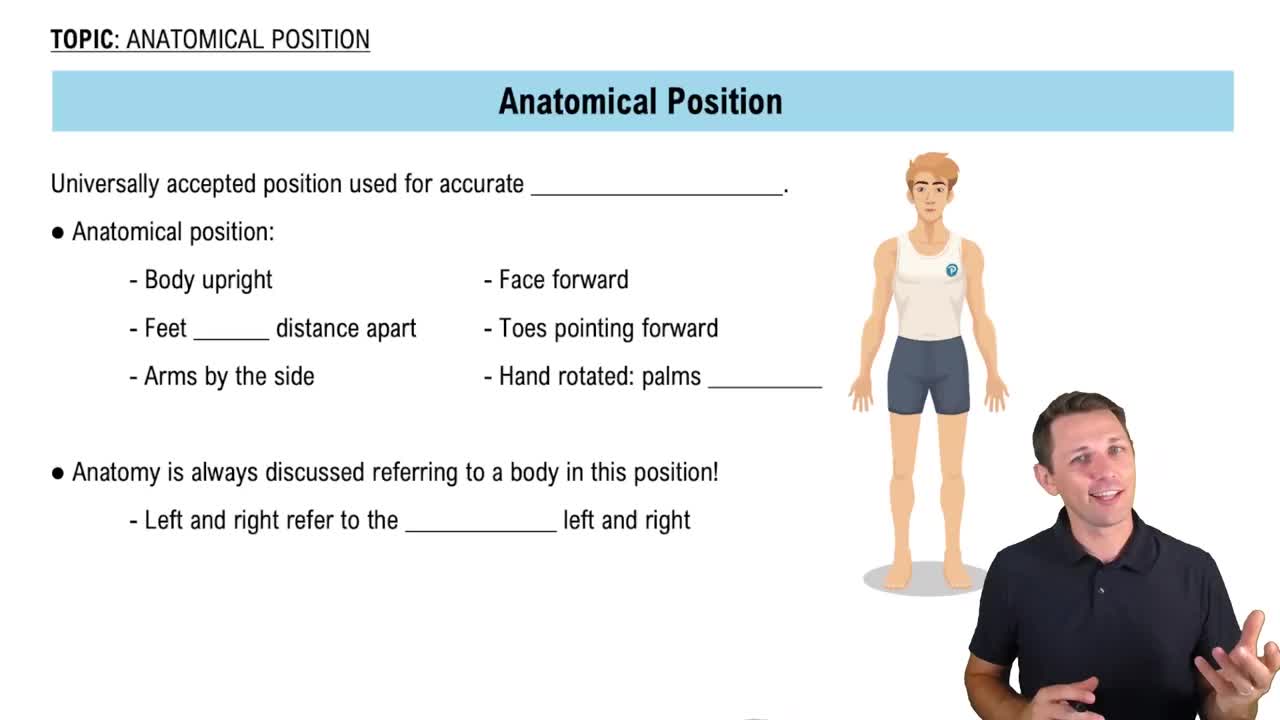
Understand that the anatomical position is a standard reference posture used in anatomy to describe locations and relationships of body parts clearly and consistently.
Recognize that in the anatomical position, the body is standing upright facing forward, which means the person is erect and looking straight ahead.
Note that the arms are positioned at the sides of the body with the palms facing forward, and the thumbs pointing away from the body.
Observe that the feet are flat on the floor and directed forward, parallel to each other.
Remember that this position serves as the baseline for anatomical terminology, so all directional terms (like anterior, posterior, medial, lateral) are defined relative to this posture.

Verified video answer for a similar problem:

This video solution was recommended by our tutors as helpful for the problem above.
Video duration:
3m
Was this helpful?

Key Concepts

Here are the essential concepts you must grasp in order to answer the question correctly.

Anatomical Position

The anatomical position is a standardized stance used as a reference in anatomy. The body stands upright, facing forward, feet together, arms at the sides with palms facing forward. This position ensures consistent and clear communication about body parts and locations.
Recommended video:
Guided course
02:40
Anatomical Position

Body Orientation Terms

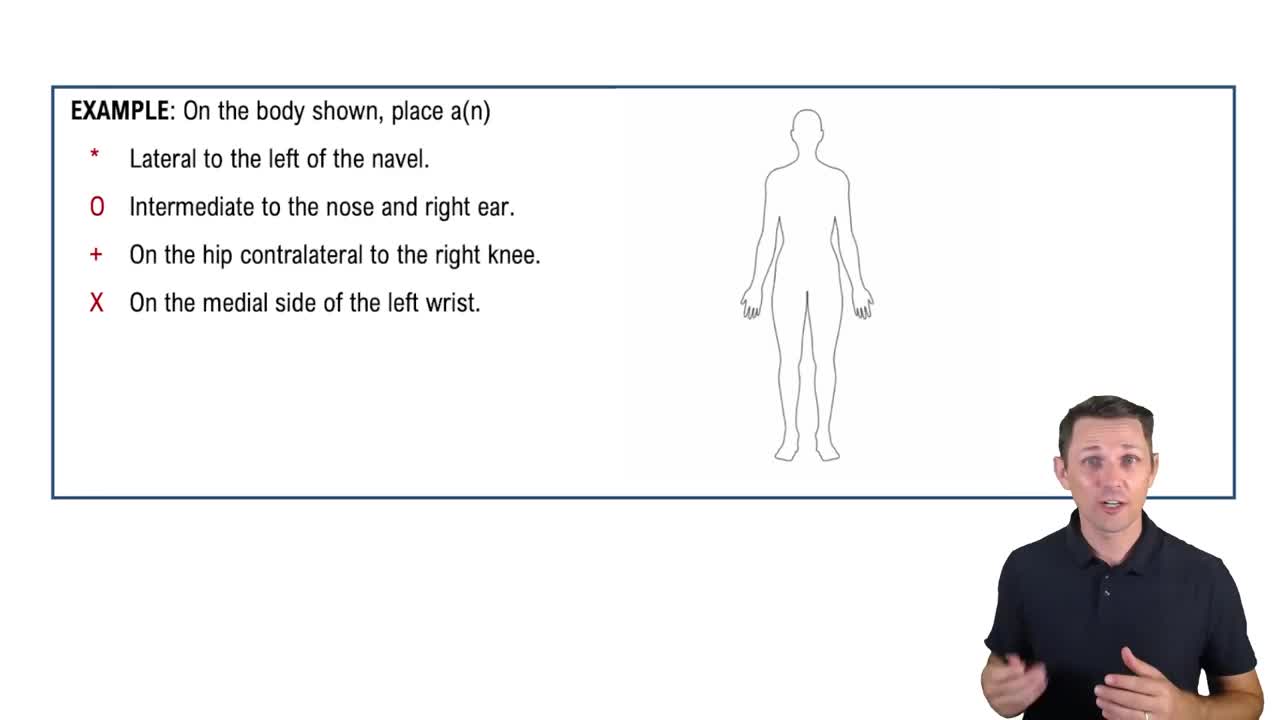
Terms like anterior (front), posterior (back), medial (toward the midline), and lateral (away from the midline) describe locations relative to the anatomical position. Understanding these terms is essential to accurately describe the position and relation of body parts.
Recommended video:
Guided course
02:24
Directional Terms: Body Sides Example 1

Purpose of Standardization in Anatomy

Standardizing the anatomical position allows healthcare professionals and students to avoid confusion when describing body parts or movements. It provides a common frame of reference regardless of the subject's actual posture or movement.
Recommended video:
03:35
Standard Sodium and Potassium Concentrations