
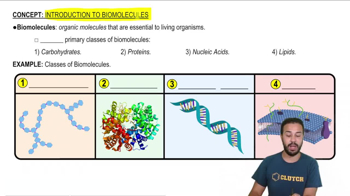

A sample that contains an organic molecule has the following constituents: carbon, hydrogen, oxygen, nitrogen, and phosphorus. Is the molecule more likely to be a carbohydrate, a lipid, a protein, or a nucleic acid?
Verified step by step guidance
1
Identify the key elements present in the molecule: carbon (C), hydrogen (H), oxygen (O), nitrogen (N), and phosphorus (P).
Recall the typical elemental composition of the four major organic macromolecules: carbohydrates (C, H, O), lipids (C, H, O), proteins (C, H, O, N), and nucleic acids (C, H, O, N, P).
Note that carbohydrates and lipids do not contain nitrogen or phosphorus, while proteins contain nitrogen but not phosphorus, and nucleic acids contain both nitrogen and phosphorus.
Based on the presence of both nitrogen and phosphorus, conclude that the molecule is most likely a nucleic acid.
Understand that nucleic acids (DNA and RNA) are composed of nucleotides, which include a phosphate group (phosphorus), a nitrogenous base (nitrogen), and a sugar (carbon, hydrogen, oxygen).
Verified video answer for a similar problem:
This video solution was recommended by our tutors as helpful for the problem above
Video duration:
2m
Play a video:
Was this helpful?
Key Concepts
Here are the essential concepts you must grasp in order to answer the question correctly.
Elemental Composition of Biomolecules
Different classes of biomolecules have characteristic elemental compositions. Carbohydrates mainly contain carbon, hydrogen, and oxygen; lipids also primarily contain these three elements; proteins contain carbon, hydrogen, oxygen, and nitrogen; nucleic acids contain carbon, hydrogen, oxygen, nitrogen, and phosphorus. Recognizing these elemental patterns helps identify the type of molecule.
Phosphorus is a key element found predominantly in nucleic acids and some lipids (like phospholipids). Its presence alongside nitrogen strongly suggests the molecule could be a nucleic acid, as proteins generally do not contain phosphorus. Understanding the significance of phosphorus helps narrow down the molecule's identity.
Distinguishing Biomolecule Classes by Functional Groups
Biomolecules differ in their functional groups and structures: carbohydrates have hydroxyl and carbonyl groups; lipids are mostly hydrophobic with long hydrocarbon chains; proteins contain amino and carboxyl groups; nucleic acids have phosphate groups and nitrogenous bases. Identifying these groups based on elemental composition aids in classifying the molecule.