What factors determine whether a chemical reaction is spontaneous or not?
Verified step by step guidance
1
Identify the concept of Gibbs Free Energy (G) which is used to determine the spontaneity of a chemical reaction.
Understand that a reaction is spontaneous if the change in Gibbs Free Energy (ΔG) is negative.
Recall the formula for Gibbs Free Energy: ΔG = ΔH - TΔS, where ΔH is the change in enthalpy, T is the temperature in Kelvin, and ΔS is the change in entropy.
Analyze how the signs and magnitudes of ΔH and ΔS, along with the temperature, affect ΔG. For example, a negative ΔH and a positive ΔS generally favor spontaneity.
Consider the role of temperature: At high temperatures, the TΔS term becomes more significant, potentially making a reaction spontaneous if ΔS is positive, even if ΔH is positive.
Verified video answer for a similar problem:
This video solution was recommended by our tutors as helpful for the problem above.
Video duration:
49s
Play a video:
0 Comments
Key Concepts
Here are the essential concepts you must grasp in order to answer the question correctly.
Gibbs Free Energy
Gibbs Free Energy (G) is a thermodynamic potential that helps predict the spontaneity of a chemical reaction. A reaction is spontaneous if the change in Gibbs Free Energy (ΔG) is negative, indicating that the process can occur without external energy input. The relationship between enthalpy, entropy, and temperature is crucial, as ΔG = ΔH - TΔS, where ΔH is the change in enthalpy and ΔS is the change in entropy.
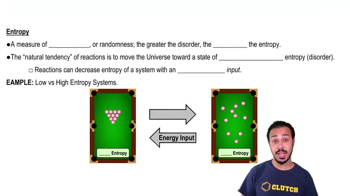
Entropy (S) is a measure of the disorder or randomness in a system. In the context of chemical reactions, an increase in entropy often favors spontaneity, as systems tend to evolve towards greater disorder. The second law of thermodynamics states that the total entropy of an isolated system can never decrease over time, which plays a key role in determining whether a reaction will occur spontaneously.
Enthalpy (H) is a measure of the total heat content of a system and is important in assessing the energy changes during a chemical reaction. A reaction is exothermic (releases heat) if ΔH is negative, which can contribute to spontaneity. Conversely, endothermic reactions (positive ΔH) may still be spontaneous if the increase in entropy is sufficient to make ΔG negative, highlighting the interplay between enthalpy and entropy in determining reaction spontaneity.

 0:49 minutes
 Verified step by step guidance
 4:58
4:58