What is chromatin?
a. the histone-containing protein core of the nucleosome
b. the 30-nm fiber
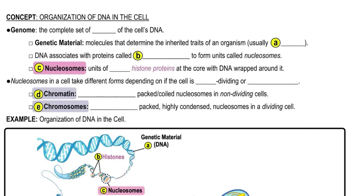
c. the complex of DNA and proteins found in the nucleus
d. the histone and non-histone proteins in eukaryotic nuclei
Verified step by step guidance
1
Identify what chromatin is composed of: Chromatin is a complex material found in the nucleus of eukaryotic cells, consisting of DNA and proteins.
Understand the role of DNA and proteins in chromatin: DNA provides the genetic information, while proteins, including histones and non-histone proteins, help in packaging the DNA into a compact, organized structure.
Recognize the components mentioned in each option: Option a mentions only the histone-containing protein core, option b refers to a specific structural form of chromatin, and option d mentions both histone and non-histone proteins but not DNA.
Compare the definitions in the options with the composition of chromatin: Chromatin is not just the protein core or a specific fiber but a complex of both DNA and proteins.
Select the option that correctly encompasses all components of chromatin: The correct option should mention both DNA and the associated proteins.
Verified video answer for a similar problem:
This video solution was recommended by our tutors as helpful for the problem above.
Video duration:
1m
Play a video:
0 Comments
Key Concepts
Here are the essential concepts you must grasp in order to answer the question correctly.
Chromatin Structure
Chromatin is a complex of DNA and proteins found in the nucleus of eukaryotic cells. It plays a crucial role in packaging DNA into a more compact, dense shape, allowing for efficient storage and regulation of gene expression. The primary proteins involved are histones, which help organize the DNA into structural units called nucleosomes.
A nucleosome is the fundamental unit of chromatin, consisting of a segment of DNA wound around a core of histone proteins. This structure resembles 'beads on a string' and is essential for DNA compaction, allowing the long DNA molecules to fit within the cell nucleus while also playing a role in gene regulation.
The 30-nm fiber is a higher-order structure of chromatin formed by the coiling and folding of nucleosomes. This level of organization is crucial for further compacting DNA and is involved in the regulation of gene accessibility, influencing how genes are expressed in different cell types.

 1:22 minutes
 Verified step by step guidance
 4:16
4:16