Name the cellular organelles, and explain the function of each.
Ch. 3 Cells and Tissues

Marieb13th EditionEssentials of Human Anatomy & PhysiologyISBN: 9780135624340Not the one you use?Change textbook
Chapter 3, Problem 14
Describe the four structural components of the plasma membrane and the function of each.
Verified step by step guidance1
Identify the four main structural components of the plasma membrane: phospholipids, proteins, carbohydrates, and cholesterol.
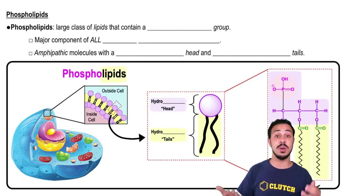
Explain the role of phospholipids: These form the bilayer structure of the membrane, with hydrophilic (water-attracting) heads facing outward and hydrophobic (water-repelling) tails facing inward. This arrangement creates a selective barrier that regulates the movement of substances in and out of the cell.
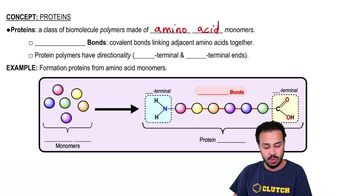
Describe the function of proteins: Membrane proteins can be integral (embedded within the bilayer) or peripheral (attached to the surface). They serve various functions, such as transport (e.g., channels and carriers), signaling (e.g., receptors), and structural support.
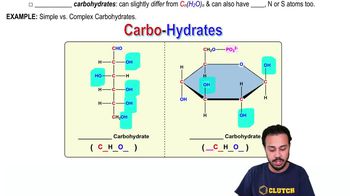
Discuss the role of carbohydrates: These are attached to proteins (glycoproteins) or lipids (glycolipids) on the extracellular surface of the membrane. They play a key role in cell recognition, communication, and adhesion.
Explain the function of cholesterol: Cholesterol molecules are interspersed within the phospholipid bilayer. They help maintain membrane fluidity and stability, preventing the membrane from becoming too rigid or too permeable under varying temperature conditions.

Verified video answer for a similar problem:
This video solution was recommended by our tutors as helpful for the problem above.
Video duration:
2mWas this helpful?
Key Concepts
Here are the essential concepts you must grasp in order to answer the question correctly.
Phospholipid Bilayer
The phospholipid bilayer is the fundamental structure of the plasma membrane, consisting of two layers of phospholipids. Each phospholipid has a hydrophilic (water-attracting) 'head' and two hydrophobic (water-repelling) 'tails.' This arrangement creates a semi-permeable barrier that allows selective passage of substances, maintaining the internal environment of the cell.
Recommended video:
Phospholipids
Proteins
Integral and peripheral proteins are embedded within or attached to the phospholipid bilayer, playing crucial roles in membrane function. Integral proteins often act as channels or transporters for molecules, while peripheral proteins are involved in signaling and maintaining the cell's shape. Together, they facilitate communication and transport across the membrane.
Recommended video:
Proteins
Carbohydrates
Carbohydrates are often attached to proteins (glycoproteins) or lipids (glycolipids) on the extracellular surface of the plasma membrane. These carbohydrate chains play essential roles in cell recognition, signaling, and adhesion, allowing cells to communicate and interact with their environment and other cells effectively.
Recommended video:
Carbohydrates
Related Practice
Textbook Question
100
views
Textbook Question
Although cells have differences that reflect their special functions in the body, what functional abilities do all cells exhibit?
81
views
Textbook Question
What is the name of the connective tissue membrane found lining the joint cavities?
36
views
Textbook Question
Describe the general characteristics of epithelial tissue. List the most important functions of epithelial tissues, and give examples of each.
44
views
Textbook Question
What are the general structural characteristics of connective tissues? What are the functions of connective tissues? How are their functions reflected in their structures?
47
views
Textbook Question
What kind of connective tissue prevents muscles from pulling away from bones during contraction?
a. Dense connective
b. Areolar
c. Elastic connective
d. Hyaline cartilage
151
views