Ch. 3 The Cellular Level of Organization
Martini - Fundamentals of Anatomy & Physiology 11th Edition
Martini, Nath, Bartholomew11th EditionFundamentals of Anatomy & PhysiologyISBN: 9780136874089Not the one you use?Change textbook
Chapter 3, Problem 13

What are the primary functions of membrane proteins?

Verified step by step guidance
1
Understand that membrane proteins are integral or peripheral proteins embedded in or attached to the lipid bilayer of cell membranes.
Identify that one primary function of membrane proteins is to act as transporters or channels, facilitating the movement of substances across the membrane that cannot pass through the lipid bilayer directly.
Recognize that membrane proteins serve as receptors, allowing cells to receive and respond to chemical signals such as hormones or neurotransmitters.
Note that membrane proteins provide structural support and help maintain the cell's shape by anchoring the cytoskeleton to the membrane or connecting cells to each other.
Acknowledge that some membrane proteins function as enzymes, catalyzing specific chemical reactions at the membrane surface.

Verified video answer for a similar problem:

This video solution was recommended by our tutors as helpful for the problem above.
Video duration:
2m
Was this helpful?

Key Concepts

Here are the essential concepts you must grasp in order to answer the question correctly.

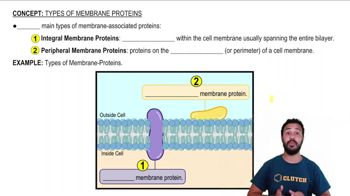
Types of Membrane Proteins

Membrane proteins are broadly classified into integral and peripheral proteins. Integral proteins span the lipid bilayer and are involved in transport and signaling, while peripheral proteins attach loosely to the membrane surface, often playing roles in signaling and maintaining the cell's shape.
Recommended video:
03:05
Types of Membrane Proteins

Transport Functions

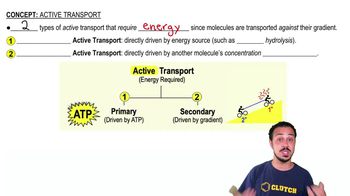
Many membrane proteins facilitate the movement of substances across the cell membrane. This includes channel proteins that allow passive diffusion and carrier proteins that actively transport molecules against concentration gradients, essential for maintaining cellular homeostasis.
Recommended video:
02:37
Active Transport

Signal Transduction and Cell Communication

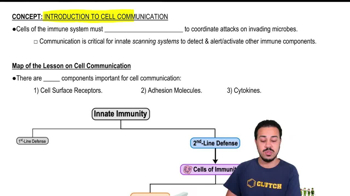
Membrane proteins act as receptors that detect external signals like hormones or neurotransmitters. Upon binding these signals, they initiate intracellular responses, enabling cells to communicate and respond to their environment effectively.
Recommended video:
2:59
Map of the Lesson on Cell Communication