Explain the relationship between electron transport and oxidative phosphorylation. How do uncoupling proteins 'uncouple' this relationship in brown adipose tissue?
Verified step by step guidance
1
Understand that electron transport and oxidative phosphorylation are two interconnected processes in cellular respiration that occur in the mitochondria.
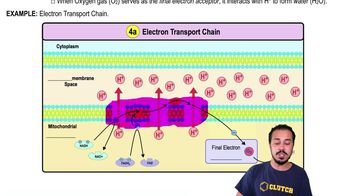
Recognize that the electron transport chain (ETC) involves a series of protein complexes (I-IV) located in the inner mitochondrial membrane, where electrons are transferred through these complexes, releasing energy.
Acknowledge that the energy released during electron transport is used to pump protons (H+) across the inner mitochondrial membrane, creating a proton gradient (proton motive force).
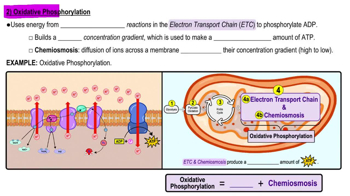
Realize that oxidative phosphorylation occurs when protons flow back into the mitochondrial matrix through ATP synthase, driven by the proton gradient, leading to the synthesis of ATP from ADP and inorganic phosphate.
Learn that uncoupling proteins, such as UCP1 in brown adipose tissue, disrupt this process by allowing protons to re-enter the mitochondrial matrix without passing through ATP synthase, thus generating heat instead of ATP, effectively 'uncoupling' electron transport from ATP production.
Was this helpful?
Key Concepts
Here are the essential concepts you must grasp in order to answer the question correctly.
Electron Transport Chain (ETC)
The Electron Transport Chain is a series of protein complexes located in the inner mitochondrial membrane that facilitate the transfer of electrons derived from NADH and FADH2. As electrons move through these complexes, they release energy, which is used to pump protons (H+) from the mitochondrial matrix into the intermembrane space, creating a proton gradient essential for ATP synthesis.
Oxidative phosphorylation is the process by which ATP is produced using the energy generated from the electron transport chain. The proton gradient created by the ETC drives protons back into the mitochondrial matrix through ATP synthase, a process that catalyzes the conversion of ADP and inorganic phosphate into ATP, thus linking electron transport to ATP production.
Uncoupling proteins are a group of proteins found in the inner mitochondrial membrane that can dissipate the proton gradient generated by the electron transport chain. In brown adipose tissue, UCPs allow protons to re-enter the mitochondrial matrix without passing through ATP synthase, leading to heat production instead of ATP synthesis, a process known as non-shivering thermogenesis.