What major events occur during anaphase of mitosis?
Verified step by step guidance
1
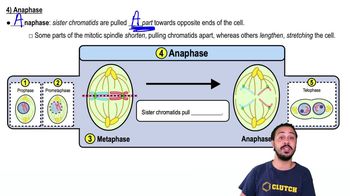
Step 1: Understand that anaphase is the fourth phase of mitosis, the process that separates the duplicated genetic material carried in the nucleus of a parent cell into two identical daughter cells.
Step 2: Recognize that during anaphase, the paired chromosomes (sister chromatids) separate and move towards opposite sides of the cell. This is facilitated by the shortening of the microtubules attached to the chromatids.
Step 3: Note that the movement of the chromosomes during anaphase is due to the action of motor proteins walking along the microtubules, combined with the shortening of the microtubules themselves.
Step 4: Understand that by the end of anaphase, the two ends of the cell have an equal collection of chromosomes.
Step 5: Remember that anaphase is followed by telophase, the final stage of mitosis, where the separated chromosomes reach the opposite poles of the cell and the nuclear membranes start to reform.
Verified video answer for a similar problem:
This video solution was recommended by our tutors as helpful for the problem above.
Video duration:
2m
Play a video:
0 Comments
Key Concepts
Here are the essential concepts you must grasp in order to answer the question correctly.
Anaphase
Anaphase is a critical stage in mitosis where sister chromatids are separated and pulled toward opposite poles of the cell. This process ensures that each daughter cell will receive an identical set of chromosomes. It follows metaphase and precedes telophase, marking a key transition in cell division.
During anaphase, the cohesin proteins that hold sister chromatids together are cleaved, allowing them to separate. Each chromatid, now an individual chromosome, is then moved to opposite ends of the cell by the spindle fibers. This separation is crucial for maintaining genetic stability in the resulting daughter cells.
The spindle apparatus is a structure made of microtubules that orchestrates the movement of chromosomes during mitosis. It is responsible for attaching to the kinetochores of the chromosomes and facilitating their movement during anaphase. Proper functioning of the spindle apparatus is essential for accurate chromosome segregation.

 2:19 minutes
 Verified step by step guidance
 02:39
02:39