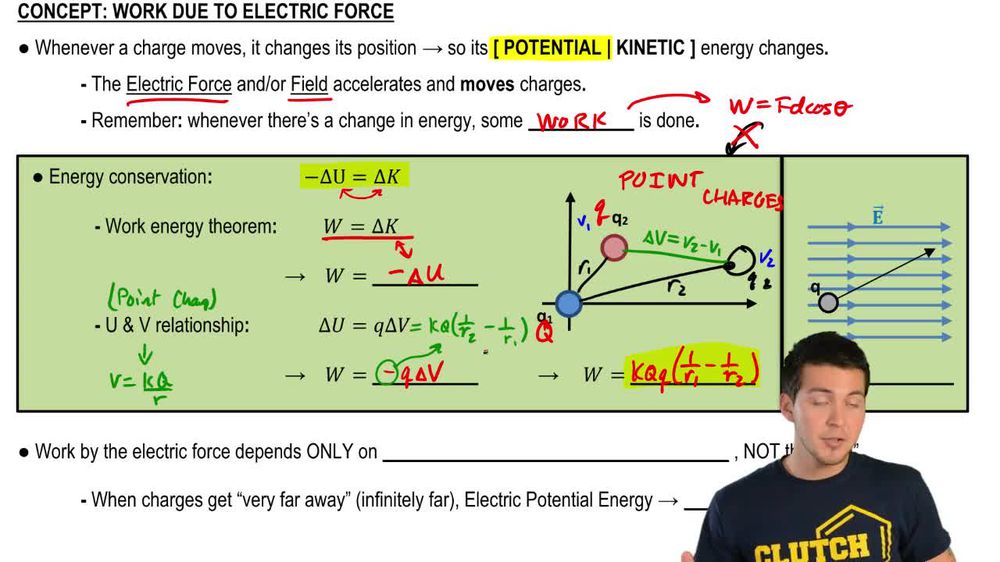
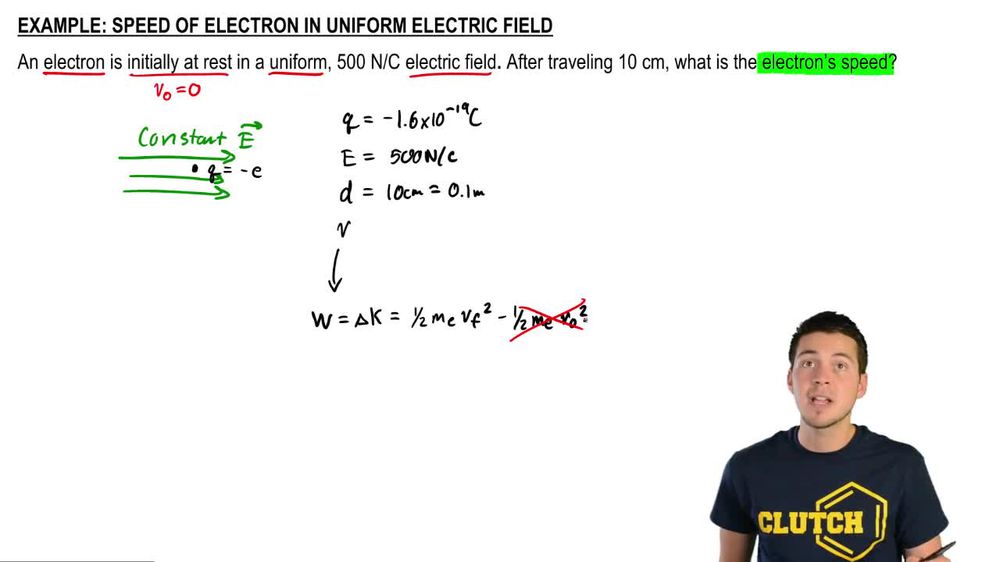
A particle with charge nC is in a uniform electric field directed to the left. The charge is released from rest and moves to the left; after it has moved cm, its kinetic energy is J. What is the work done by the electric force?
25. Electric Potential
Work From Electric Force
- Textbook Question2424views
- Textbook Question
A parallel-plate capacitor with a 1.0 mm plate separation is charged to 75 V. With what kinetic energy, in eV, must a proton be launched from the negative plate if it is just barely able to reach the positive plate?
1065views - Textbook Question
A 1.5 V battery provides 0.50 A of current. How much work does the charge escalator do to lift 1.0 C of charge?
1182views - Textbook Question
Light from the sun allows a solar cell to move electrons from the positive to the negative terminal, doing 2.4×10⁻¹⁹ J of work per electron. What is the emf of this solar cell?
915views - Multiple Choice
A point charge is moved by the electric force from point a, which is at electric potential , to point d, which is at electric potential . What is the work done by the electric force during this process?
32views - Multiple Choice
An electron moves from point A to point B. The potential difference between these two points is 100 V. What is
a. the point of higher potential?
b. the work done on the electron?
c. the final speed of the electron if its initial speed is zero?
2317views25rank7comments - Textbook Question
A proton's speed as it passes point 1 is 50,000 m/s. It follows the trajectory shown in FIGURE P25.43. What is the proton's speed at point 2?
1846views - Textbook Question
The luminous efficiency of a lightbulb is the ratio of luminous flux to electric power input.
(a) What is the luminous efficiency of a 100-W, 1600-lm bulb?
(b) How many 40-W, 60-lm/W fluorescent lamps would be needed to provide an illuminance of 250 lm/m² on a factory floor of area 22 m x 30 m? Assume the lights are 10 m above the floor and that half their flux reaches the floor.
46views - Textbook Question
An arrangement of source charges produces the electric potential V=5000x2 along the x-axis, where V is in volts and x is in meters. What is the maximum speed of a 1.0 g, 10 nC charged particle that moves in this potential with turning points at ±8.0 cm?
1374views - Textbook Question
(II) A + 25 μC point charge is placed 6.0 cm from an identical +25 μC point charge. How much work would be required by an external force to move a +0.15 μC test charge from a point midway between them to a point 1.0 cm closer to either of the charges?
1378views - Textbook Question
In an older television tube (CRT), electrons are accelerated by thousands of volts through a vacuum. If such a television set is laid on its back, would electrons be able to move upward against the force of gravity? What potential difference, acting over a distance of 2.4 cm, would be needed to balance the downward force of gravity so that an electron would remain stationary? Assume that the electric field is uniform.
1011views - Multiple ChoiceHow much work does a battery do when it moves from the negative terminal to the positive terminal?1340views
- Multiple ChoiceWhat is the speed of a proton that has been accelerated through ?1590views